Alan Turing
Mathematician · Computer scientist · Cryptanalyst · Logician
1912–1954 · Born in Maida Vale, London, England · 3 min read
- Last verified: 12 November 2026
- Sources: 4
- Reviewed by Muse — Phase D second review (independent check)
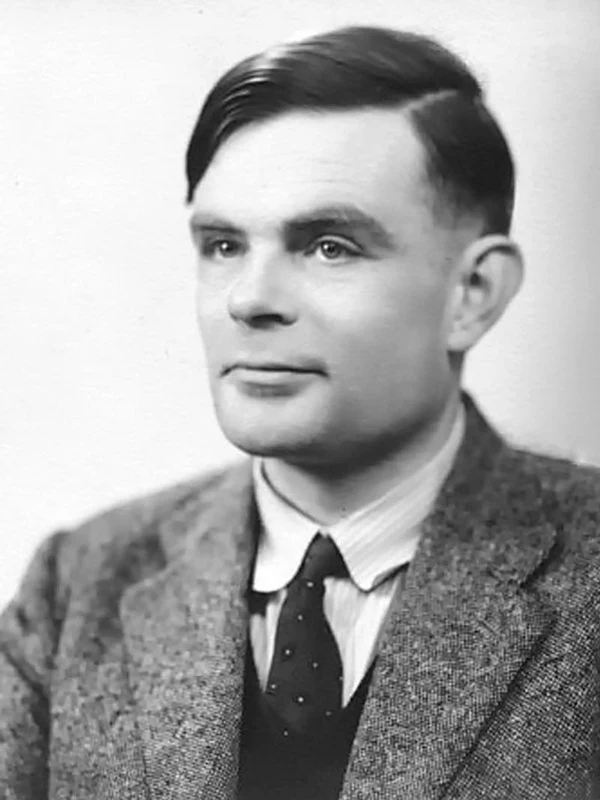
British mathematician who defined modern computing with the Turing machine, broke German naval Enigma at Bletchley Park, and proposed the Turing test; posthumously pardoned after his 1952 conviction.
Early Life
Alan Mathison Turing was born on 23 June 1912 in Maida Vale, London, the younger son of Julius Mathison Turing, a civil servant in the Indian Civil Service, and Ethel Sara Stoney. He was raised in southern England and educated at Sherborne School, where his talent for mathematics and science stood out early. He read widely in science and mathematics as a schoolboy, and in 1931 he entered King's College, Cambridge, to study mathematics.
Education
Turing studied mathematics at King's College, Cambridge, from 1931, graduating with first-class honours in 1934. He was elected a fellow of King's College in 1935. From 1936 to 1938 he studied at Princeton University in the United States, where he completed a PhD in mathematical logic under Alonzo Church.
Career
In 1936 Turing published 'On Computable Numbers, with an Application to the Entscheidungsproblem', introducing the Turing machine, an abstract model that defined what a computer could in principle do. On 4 September 1939, the day after Britain declared war on Germany, he reported to the Government Code and Cypher School at Bletchley Park. There he led Hut 8, the section attacking German naval Enigma, and with Gordon Welchman designed the Bombe, an electromechanical machine that found each day's Enigma settings. After the war he designed the Automatic Computing Engine (ACE) at the National Physical Laboratory, then moved to the University of Manchester in 1948 to work on the Manchester Mark 1 computer. In 1950 he published 'Computing Machinery and Intelligence', proposing the imitation game now known as the Turing test. In March 1952 he was convicted of gross indecency for a relationship with another man and sentenced to chemical castration by oestrogen injections. He died on 7 June 1954 at Wilmslow, aged 41.
Achievements
Turing's central achievement was founding the theoretical basis of computing before any electronic computer existed. His 1936 paper defined computability through the Turing machine and proved there are problems no machine can solve. At Bletchley Park his Bombe design and his methods for breaking naval Enigma helped protect Atlantic convoys from U-boats. His post-war ACE design was one of the first plans for a stored-program computer, and his 1950 paper launched the philosophical study of artificial intelligence with the imitation game. His 1952 paper on morphogenesis, 'The Chemical Basis of Morphogenesis', founded the mathematical study of pattern formation in biology. Official recognition came late: the British government apologised in 2009, Queen Elizabeth II granted a royal pardon in December 2013, a 2017 law known as the 'Alan Turing law' pardoned thousands of other men convicted under the same historic legislation, and Turing's portrait appeared on the Bank of England's 50-pound note from June 2021.
Legacy
Turing is regarded as the father of computer science and a founder of artificial intelligence. The Turing machine remains the standard model of computation, and the imitation game he proposed in 1950 is still the reference point for debates about machine intelligence. His wartime codebreaking is widely credited with shortening the Second World War. His prosecution and death became a landmark in the campaign for LGBT rights in Britain, and the campaign for his pardon helped change the law for thousands of others. The Association for Computing Machinery's A.M. Turing Award, computing's highest honour, is named for him.
Major Achievements
- Published 'On Computable Numbers' in 1936, introducing the Turing machine and defining the limits of computation
- Designed the Bombe with Gordon Welchman at Bletchley Park, breaking German naval Enigma and aiding the Battle of the Atlantic
- Led Hut 8, the Bletchley Park section responsible for German naval cryptanalysis
- Designed the Automatic Computing Engine (ACE) at the National Physical Laboratory after the war
- Published 'Computing Machinery and Intelligence' in 1950, proposing the imitation game now known as the Turing test
- Published 'The Chemical Basis of Morphogenesis' in 1952, founding the mathematical study of biological pattern formation
- Elected a Fellow of the Royal Society in 1951
- Posthumously pardoned by Queen Elizabeth II in December 2013; the 2017 'Alan Turing law' extended pardons to thousands of others convicted under the same legislation
- Featured on the Bank of England's 50-pound note from June 2021
Contributions
Turing's work joined abstract logic with practical machines. The Turing machine gave the first rigorous definition of computation and its limits, and the universal machine in the same paper is the conceptual ancestor of the stored-program computer. At Bletchley Park he turned that theory into working cryptanalysis, specifying machines that searched Enigma settings far faster than any human could. His 1950 paper reframed the question of machine intelligence as an experimental test rather than a metaphysical debate, and his morphogenesis paper showed that simple chemical rules could explain complex biological patterns.
Notable Works
- On Computable Numbers, with an Application to the Entscheidungsproblem (1936)
- Computing Machinery and Intelligence (1950)
- The Chemical Basis of Morphogenesis (1952)
- The Bombe (design, 1939-1940)
- Automatic Computing Engine (ACE) design (1946)
Milestones
- 1931 — Entered King's College, Cambridge, to study mathematics Source: Encyclopaedia Britannica
- 1935 — Elected a fellow of King's College, Cambridge Source: Encyclopaedia Britannica
- 1936 — Published 'On Computable Numbers', introducing the Turing machine Source: Encyclopaedia Britannica
- 1938 — Completed a PhD in mathematical logic at Princeton University under Alonzo Church Source: Encyclopaedia Britannica
- 1939 — Reported to Bletchley Park on 4 September 1939 to work on German ciphers Source: Encyclopaedia Britannica
- 1940 — Designed the Bombe with Gordon Welchman to find daily Enigma settings Source: Bank of England; Encyclopaedia Britannica
- 1941 — Led Hut 8 in breaking German naval Enigma, helping protect Atlantic convoys Source: Encyclopaedia Britannica
- 1945 — Presented the design for the Automatic Computing Engine (ACE) at the National Physical Laboratory Source: Encyclopaedia Britannica
- 1948 — Moved to the University of Manchester to work on the Manchester Mark 1 computer Source: Encyclopaedia Britannica
- 1950 — Published 'Computing Machinery and Intelligence', proposing the imitation game (Turing test) Source: Encyclopaedia Britannica
- 1951 — Elected a Fellow of the Royal Society Source: Encyclopaedia Britannica
- 1952 — Convicted of gross indecency; published his paper on morphogenesis Source: Encyclopaedia Britannica; Bank of England
- 2013 — Granted a royal pardon by Queen Elizabeth II for the 1952 conviction Source: Bank of England; BBC News
- 2021 — Became the face of the Bank of England's 50-pound note Source: Bank of England
Timeline
- 23 June 1912
Born in Maida Vale, London
Source: Encyclopaedia Britannica - 1931
Entered King's College, Cambridge, to study mathematics
Year only — exact date unknown Source: Encyclopaedia Britannica - 1935
Elected a fellow of King's College, Cambridge
Year only — exact date unknown Source: Encyclopaedia Britannica - 1936
Published 'On Computable Numbers', introducing the Turing machine
Year only — exact date unknown Source: Encyclopaedia Britannica - 1938
Completed his PhD at Princeton University under Alonzo Church
Year only — exact date unknown Source: Encyclopaedia Britannica - 4 September 1939
Reported to Bletchley Park to work on German ciphers
Source: Encyclopaedia Britannica - 1940
Designed the Bombe with Gordon Welchman
Year only — exact date unknown Source: Bank of England; Encyclopaedia Britannica - 1945
Presented the ACE design at the National Physical Laboratory
Year only — exact date unknown Source: Encyclopaedia Britannica - 1948
Moved to the University of Manchester to work on the Manchester Mark 1
Year only — exact date unknown Source: Encyclopaedia Britannica - 1950
Published 'Computing Machinery and Intelligence', proposing the imitation game
Year only — exact date unknown Source: Encyclopaedia Britannica - 1952-03
Convicted of gross indecency and sentenced to chemical castration
Approximate date Source: Encyclopaedia Britannica; Bank of England - 7 June 1954
Died at Wilmslow, Cheshire, aged 41, of cyanide poisoning
Source: Encyclopaedia Britannica - 2013-12
Granted a royal pardon by Queen Elizabeth II
Approximate date Source: Bank of England; BBC News - 23 June 2021
The Bank of England's 50-pound note featuring Turing entered circulation
Source: Bank of England
In Their Words
“We can only see a short distance ahead, but we can see plenty there that needs to be done.” Source: A. M. Turing, 'Computing Machinery and Intelligence', Mind, vol. 59, no. 236 (October 1950), closing line — Closing line of the paper that proposed the imitation game (Turing test).
Related Personalities
Frequently Asked Questions
Who was Alan Turing?
Alan Turing (1912-1954) was a British mathematician and logician who founded the theoretical basis of computer science with his 1936 paper on computable numbers, broke German naval Enigma at Bletchley Park during the Second World War, and proposed the Turing test for machine intelligence in 1950.
Source: Encyclopaedia BritannicaWhat is the Turing machine?
The Turing machine is an abstract model of computation Turing described in his 1936 paper 'On Computable Numbers'. It is a simple imaginary device that reads and writes symbols on a tape according to rules, and it defines what it means for a problem to be computable. The universal Turing machine in the same paper is the conceptual ancestor of the modern stored-program computer.
Source: Encyclopaedia BritannicaWhat did Turing do at Bletchley Park?
Turing joined the Government Code and Cypher School at Bletchley Park on 4 September 1939. He led Hut 8, the section attacking German naval Enigma, and with Gordon Welchman designed the Bombe, a machine that found each day's Enigma settings. His work helped protect Atlantic convoys from U-boats and is widely credited with shortening the war.
Source: Encyclopaedia Britannica; Bank of EnglandWhy was Turing prosecuted?
In March 1952 Turing was convicted of gross indecency for a relationship with another man, under laws that criminalised homosexual acts in Britain at the time. He was sentenced to chemical castration by oestrogen injections and lost his security clearance. The British government apologised in 2009 and Queen Elizabeth II granted him a royal pardon in December 2013.
Source: Encyclopaedia Britannica; Bank of EnglandHow was Turing recognised after his death?
Beyond the 2009 apology and 2013 royal pardon, a 2017 law known as the 'Alan Turing law' pardoned thousands of other men convicted under the same historic legislation. In June 2021 Turing became the face of the Bank of England's 50-pound note, and computing's highest honour, the ACM's A.M. Turing Award, is named for him.
Source: Bank of England; Encyclopaedia BritannicaSources & References
- Alan Turing — Encyclopaedia Britannica — Encyclopaedia Britannica (accessed 12 November 2026)
- Alan Turing to be the face of new £50 note — Bank of England — Bank of England (accessed 12 November 2026)
- Alan Turing — Wikipedia (cross-check) — Wikipedia (accessed 12 November 2026)
- File:Alan Turing (1951).jpg — Wikimedia Commons (portrait file page) — Wikimedia Commons (accessed 12 November 2026)
