Faiz Ahmed Faiz
Poet · Journalist · Editor
1911–1984 · Born in Kala Qadir, Sialkot, Punjab, British India (now Pakistan) · 4 min read
- Last verified: 12 November 2026
- Sources: 6
- Reviewed by Muse — Phase C second review (independent check)
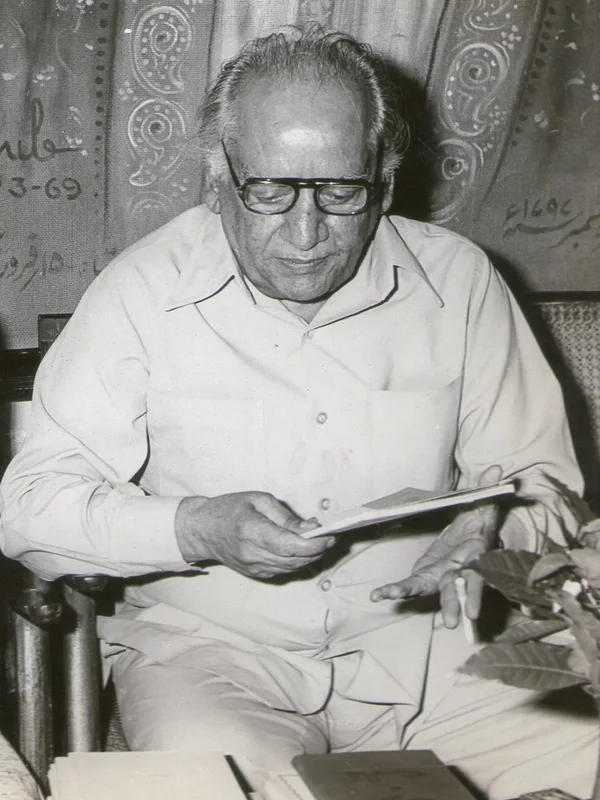
Pakistan's most celebrated modern Urdu poet, whose verse joined romantic lyricism with resistance to injustice; editor of the Pakistan Times and Lenin Peace Prize laureate.
Early Life
Faiz Ahmed Faiz was born on 13 February 1911 at Kala Qadir, a village near Sialkot in the Punjab of British India (now Pakistan). His father, Sultan Muhammad Khan, had been a poor shepherd boy who taught himself Persian, Urdu and English and became a barrister. Faiz was taught classical Persian and Arabic by the scholar Shams al-Ulama Sayyid Mir Hasan — the same teacher who had taught Iqbal — and was educated at Scotch Mission School and Murray College in Sialkot, sharing his home town with Pakistan's national poet, Allama Muhammad Iqbal.
Education
Faiz studied at Government College Lahore, where he took an MA in English, and at Oriental College Lahore, where he took an MA in Arabic. He went to Government College on the personal recommendation of Allama Iqbal, who had been impressed by the young poet.
Career
Faiz began his career as a lecturer in English at M.A.O. College, Amritsar, in 1935, then taught at Hailey College of Commerce, Lahore, from 1940. From 1938 he edited the literary monthly Adab-e-Latif. In 1942 he joined the British Indian Army's public relations department, rising to lieutenant colonel and receiving the MBE before resigning in 1947. After independence he became the first editor-in-chief of the Pakistan Times and the Urdu daily Imroze, and a leading member of the Progressive Writers' Movement. In 1951 he was arrested in the Rawalpindi Conspiracy Case, accused of involvement in an attempted coup, and spent four years in prison; he was imprisoned again for over five months in 1958-1959. After his release he returned to journalism, served as secretary of the Arts Council, Lahore, from 1959 to 1962, and worked as a cultural adviser in Zulfikar Ali Bhutto's government in the 1970s. After General Zia-ul-Haq's coup in 1977 he went into self-exile, and from 1979 to 1982 he lived in Beirut, editing Lotus, the journal of the Afro-Asian Writers' Association, until the Israeli invasion forced him to leave. He returned to Lahore in 1983 and died there the following year.
Achievements
Faiz's achievement was to remake Urdu poetry so that it could carry both romantic lyricism and political resistance in the same line. His first collection, Naqsh-e-Faryadi (1941), established him as a major voice; the collections written in prison, Dast-e-Saba (1952) and Zindan-Nama (1956), turned his imprisonment into some of the most quoted verse in the language. His poem 'Mujh se pehli si mohabbat mere mehboob na maang' became one of the most famous Urdu poems of the century, and 'Hum Dekhenge', written in 1979, became an anthem of protest, famously sung by Iqbal Bano under military rule. International recognition came with the Lenin Peace Prize in 1962 — he was the first Asian poet to receive it — and the Lotus Prize for Literature in 1976. Pakistan awarded him the Nishan-e-Imtiaz posthumously in 1990, and his collected works, Nuskha-ha-e-Wafa, appeared in 1984.
Legacy
Faiz is remembered as Pakistan's most celebrated modern Urdu poet and as a voice of conscience against military rule, censorship and inequality. His poems are sung, quoted at protests, and taught in schools across South Asia; 'Hum Dekhenge' has been translated and performed in many languages and became a rallying cry in the protests against India's Citizenship Amendment Act in 2019-2020. His work was translated into English by, among others, Agha Shahid Ali and Naomi Lazard, and his prison letters and the authorised biography by his grandson Ali Madeeh Hashmi have kept his life in public view. He died of cardiac arrest in Lahore on 20 November 1984. The Faiz Foundation and the annual Faiz Festival in Lahore continue to celebrate his work.
Major Achievements
- Published Naqsh-e-Faryadi (1941), his first poetry collection, which made him a leading voice of modern Urdu poetry
- Wrote Dast-e-Saba (1952) and Zindan-Nama (1956), collections composed during four years of imprisonment after the Rawalpindi Conspiracy Case
- Awarded the Lenin Peace Prize in 1962, the first Asian poet to receive the Soviet Union's highest international honour
- Wrote 'Hum Dekhenge' (1979), which became an anthem of protest across South Asia
- Served as the first editor-in-chief of the Pakistan Times and Imroze from 1947, shaping journalism in the new country
- Edited Lotus, the journal of the Afro-Asian Writers' Association, from Beirut during his self-exile (1979-1982)
- Awarded the Lotus Prize for Literature in 1976 and the Nishan-e-Imtiaz, Pakistan's highest civilian honour, posthumously in 1990
- His collected works, Nuskha-ha-e-Wafa, were published in 1984, the year of his death
Contributions
Faiz's contribution was to prove that Urdu poetry could be both beautiful and politically committed. In the Progressive Writers' Movement he helped turn literature toward social realism, writing ghazals and nazms that spoke of love, prison, exile and hope in the same breath. As a journalist he set a standard for independent editorial writing in Pakistan's early years, and as editor of Lotus he connected South Asian writing with the anti-colonial literary movements of Africa and the Arab world. His verse gave the language of resistance to generations of readers who had never met him, and it remains the most quoted body of modern Urdu poetry.
Notable Works
- Naqsh-e-Faryadi (1941)
- Dast-e-Saba (1952)
- Zindan-Nama (1956)
- Dast-e-Tah-e-Sang (1965)
- Sar-e-Wadi-e-Sina (1971)
- Sham-e-Shehr-e-Yaran (1979)
- Mere Dil Mere Musafir
- Nuskha-ha-e-Wafa (1984, collected works)
- Hum Dekhenge (poem, 1979)
Milestones
- 1911 — Born on 13 February at Kala Qadir, Sialkot, Punjab, British India (now Pakistan) Source: Dawn; Faiz Centenary timeline
- 1935 — Becomes a lecturer in English at M.A.O. College, Amritsar Source: Dawn; Nazaria-i-Pakistan Trust
- 1941 — Publishes his first poetry collection, Naqsh-e-Faryadi Source: Encyclopaedia of Islam; Dawn
- 1942 — Joins the British Indian Army, rising to lieutenant colonel Source: Encyclopaedia of Islam; Nazaria-i-Pakistan Trust
- 1947 — Becomes the first editor-in-chief of the Pakistan Times and Imroze in Lahore Source: Encyclopaedia of Islam; Nazaria-i-Pakistan Trust
- 1951 — Arrested in the Rawalpindi Conspiracy Case; sentenced to four years' imprisonment Source: Dawn; Encyclopaedia of Islam
- 1955 — Released from prison; returns to journalism and the Progressive Writers' Movement Source: Encyclopaedia of Islam
- 1962 — Awarded the Lenin Peace Prize, the first Asian poet to receive it Source: Faiz Centenary timeline; Dawn
- 1976 — Awarded the Lotus Prize for Literature Source: Geo News; MM News
- 1979 — Writes 'Hum Dekhenge'; becomes editor of Lotus and moves to Beirut in self-exile Source: Dawn; Souffles Monde
- 1982 — Flees Beirut during the Israeli invasion; returns to Lahore in 1983 Source: Souffles Monde; Dawn
- 1984 — Dies of cardiac arrest in Lahore on 20 November, aged 73 Source: Dawn; Geo News
- 1990 — Awarded the Nishan-e-Imtiaz posthumously, Pakistan's highest civilian honour Source: Geo News; MM News
Timeline
- 13 February 1911
Born at Kala Qadir, Sialkot, Punjab, British India (now Pakistan)
Source: Dawn; Faiz Centenary timeline - 1935
Becomes a lecturer in English at M.A.O. College, Amritsar
Year only — exact date unknown Source: Dawn; Nazaria-i-Pakistan Trust - 1941
Publishes his first poetry collection, Naqsh-e-Faryadi
Year only — exact date unknown Source: Encyclopaedia of Islam; Dawn - 1942
Joins the British Indian Army; rises to lieutenant colonel
Year only — exact date unknown Source: Encyclopaedia of Islam; Nazaria-i-Pakistan Trust - 1947
Becomes first editor-in-chief of the Pakistan Times and Imroze in Lahore
Year only — exact date unknown Source: Encyclopaedia of Islam; Nazaria-i-Pakistan Trust - 1951
Arrested in the Rawalpindi Conspiracy Case and sentenced to four years' imprisonment
Year only — exact date unknown Source: Dawn; Encyclopaedia of Islam - 1955
Released from prison; returns to journalism
Year only — exact date unknown Source: Encyclopaedia of Islam - 1962
Awarded the Lenin Peace Prize, the first Asian poet to receive it
Year only — exact date unknown Source: Faiz Centenary timeline; Dawn - 1976
Awarded the Lotus Prize for Literature
Year only — exact date unknown Source: Geo News; MM News - 1979
Writes 'Hum Dekhenge'; becomes editor of Lotus and moves to Beirut in self-exile
Year only — exact date unknown Source: Dawn; Souffles Monde - 1982
Flees Beirut during the Israeli invasion; returns to Lahore in 1983
Year only — exact date unknown Source: Souffles Monde; Dawn - 20 November 1984
Dies of cardiac arrest in Lahore, aged 73
Source: Dawn; Geo News - 1990
Awarded the Nishan-e-Imtiaz posthumously by the Government of Pakistan
Year only — exact date unknown Source: Geo News; MM News
Related Personalities
Frequently Asked Questions
Who was Faiz Ahmed Faiz?
Faiz Ahmed Faiz (1911-1984) was a Pakistani poet, journalist and editor, widely regarded as the most celebrated modern Urdu poet. His verse joined romantic lyricism with resistance to injustice, and he was a leading figure of the Progressive Writers' Movement.
Source: Dawn; Encyclopaedia of IslamWhy was Faiz imprisoned?
In 1951 Faiz was arrested in the Rawalpindi Conspiracy Case, accused of complicity in an attempted coup against the government of Prime Minister Liaquat Ali Khan. He was sentenced to four years' imprisonment and was released in 1955. Two of his best-known collections, Dast-e-Saba and Zindan-Nama, were written in prison.
Source: Dawn; Encyclopaedia of IslamWhat is 'Hum Dekhenge'?
'Hum Dekhenge' ('We Shall See') is a poem Faiz wrote in 1979, first published in his collection Mere Dil Mere Musafir. Sung by Iqbal Bano under General Zia-ul-Haq's military rule, it became an anthem of protest in Pakistan and, decades later, in India.
Source: DawnWhat was the Lenin Peace Prize?
The Lenin Peace Prize was the Soviet Union's highest international honour, roughly equivalent to the Nobel Peace Prize. Faiz received it in 1962, the first Asian poet to do so, travelling to Moscow to accept it despite warnings from Pakistan's military government.
Source: Faiz Centenary timeline; DawnWhy did Faiz live in Beirut?
After General Zia-ul-Haq's coup in 1977, Faiz went into self-exile. From 1979 to 1982 he lived in Beirut, Lebanon, editing Lotus, the journal of the Afro-Asian Writers' Association, until the Israeli invasion of June 1982 forced him to leave. He returned to Lahore in 1983.
Source: Souffles Monde; DawnSources & References
- Faiz Ahmed Faiz: Life and poetry — Dawn (accessed 12 November 2026)
- Timeline Faiz Ahmed Faiz — Faiz Centenary Celebration 2011 (accessed 12 November 2026)
- Fayd, Fayd Ahmad — Tariq Rahman — Encyclopaedia of Islam, THREE (via ResearchGate) (accessed 12 November 2026)
- Faiz Ahmed Faiz's 108th birth anniversary being observed today — Geo News (accessed 12 November 2026)
- You Had No Address: Faiz Ahmed Faiz in Beirut — Souffles Monde (accessed 12 November 2026)
- File:Faiz Ahmed Faiz (cropped).jpg — Wikimedia Commons (portrait file page) — Wikimedia Commons (accessed 12 November 2026)
