Leonardo da Vinci
Artist and inventor · Painter · Draftsman · Sculptor · Architect · Engineer · Inventor · Anatomist
1452–1519 · Born in Anchiano, near Vinci, Republic of Florence (now Italy) · 3 min read
- Last verified: 12 November 2026
- Sources: 4
- Reviewed by Muse — Phase D second review (independent check)
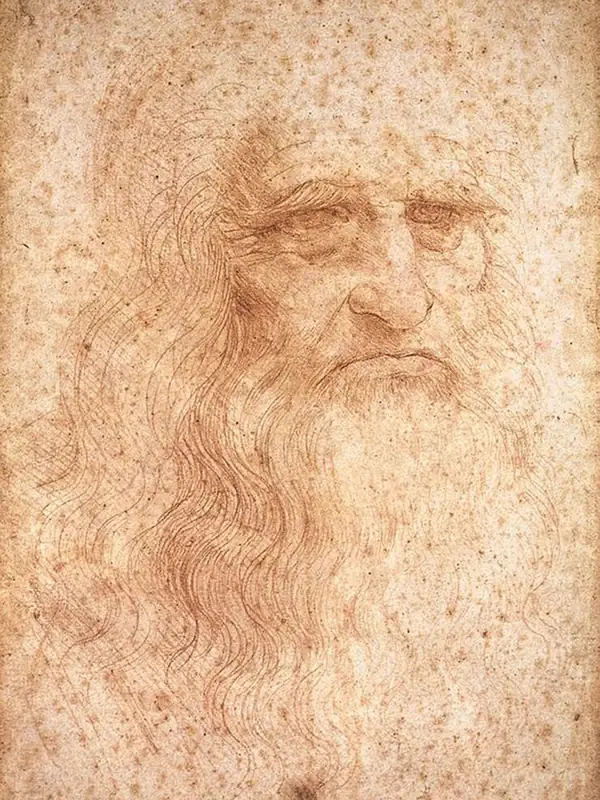
Italian Renaissance painter, draftsman and inventor — creator of the Mona Lisa and The Last Supper — whose notebooks joined art with anatomy, engineering and the study of flight.
Early Life
Leonardo was born on 15 April 1452 at Anchiano, near the Tuscan town of Vinci, in the Republic of Florence. He was the illegitimate son of the notary Ser Piero and a peasant woman named Caterina, and was raised in Vinci. As a boy he was apprenticed to Andrea del Verrocchio in Florence, the leading workshop of the day, where he learned painting, sculpture, perspective and metalwork. He was admitted to the painters' guild of Florence in 1472.
Education
Leonardo's formal training was his apprenticeship in Andrea del Verrocchio's workshop in Florence, from about 1466, where he learned painting, sculpture, metalwork and perspective. He had little formal schooling; his knowledge of anatomy, engineering, optics and natural science was largely self-taught, gained from observation, dissection and experiment recorded in his notebooks.
Career
Leonardo was apprenticed as a boy to the Florentine artist Andrea del Verrocchio, in whose workshop he learned painting, sculpture and metalwork, and was admitted to the painters' guild in Florence in 1472. His early Florentine works include the Annunciation (c. 1472–75) and the unfinished Adoration of the Magi, begun in 1481. In 1482 he moved to Milan to work for Ludovico Sforza, offering his services as a military engineer as well as an artist; there he painted the Virgin of the Rocks and The Last Supper (1495–98), and worked on a colossal equestrian monument that was never cast. He drew the Vitruvian Man in about 1490. In 1502 he worked as a military engineer for Cesare Borgia, and back in Florence he began the Mona Lisa in about 1503 and the Battle of Anghiari, which he left unfinished. He spent his last years in Rome and then in France, where King Francis I invited him in 1516; he died at Cloux, now Clos-Lucé, near Amboise, on 2 May 1519. His notebooks, dispersed after his death, survive in collections including the Royal Library at Windsor, the Biblioteca Ambrosiana in Milan and the Louvre.
Achievements
Leonardo's paintings include the Mona Lisa (c. 1503–19), now in the Louvre in Paris, and The Last Supper (1495–98) in the monastery of Santa Maria delle Grazie in Milan, two of the most famous paintings in the world. His drawing of the Vitruvian Man (c. 1490) is a landmark study of human proportion. He also painted the Virgin of the Rocks and the Lady with an Ermine (c. 1489–91). As an inventor and investigator he filled thousands of notebook pages — many written in mirror script — with studies of anatomy, mechanics, optics, hydraulics and flight, and designed flying machines, a parachute, an armoured vehicle, bridges and military engines centuries ahead of their time. His anatomical drawings, made from dissections, were among the most accurate of the Renaissance.
Legacy
Leonardo is the archetype of the Renaissance ideal of a universal mind: a painter of unmatched fame whose curiosity extended to anatomy, engineering, optics, geology, hydraulics and flight. The Mona Lisa and The Last Supper are among the most reproduced images in the world, and the Vitruvian Man has become a symbol of the Renaissance itself. His notebooks, with their mirror writing and thousands of drawings, show a method of close observation that anticipated modern science, and his designs for flying machines and other devices were centuries ahead of what could be built. Fewer than twenty paintings are generally accepted as his work, and each is studied intensively.
Major Achievements
- Painted the Mona Lisa (c. 1503–19), now in the Louvre, Paris, and The Last Supper (1495–98) in Santa Maria delle Grazie, Milan
- Drew the Vitruvian Man (c. 1490), a study of human proportion
- Painted the Virgin of the Rocks and the Lady with an Ermine (c. 1489–91)
- Filled thousands of notebook pages with studies of anatomy, mechanics, optics, hydraulics and flight, written in mirror script
- Designed flying machines, a parachute, an armoured vehicle, bridges and military engines, centuries ahead of their time
- Made hundreds of anatomical drawings from dissections, among the most accurate of the Renaissance
Contributions
Leonardo's contribution to art is a small number of paintings of extraordinary fame and influence, above all the Mona Lisa and The Last Supper, and a method of painting built on close observation of nature, anatomy and light. His contribution to science and engineering lies in thousands of notebook pages: anatomical studies, designs for flying machines, bridges, weapons and machines, and observations of water, light and the human body that were far ahead of his time.
Notable Works
- Annunciation (c. 1472–75)
- Adoration of the Magi (begun 1481, unfinished)
- Virgin of the Rocks (c. 1483–86)
- Lady with an Ermine (c. 1489–91)
- The Last Supper (1495–98)
- Vitruvian Man (c. 1490)
- Mona Lisa (c. 1503–19)
- Battle of Anghiari (begun 1503, unfinished)
Milestones
- c. 1466 — Apprenticed to the artist Andrea del Verrocchio in Florence (approximate year) Source: Encyclopaedia Britannica; Wikipedia
- 1472 — Admitted to the painters' guild of Florence Source: Encyclopaedia Britannica
- c. 1472–75 — Painted the Annunciation (approximate date) Source: Encyclopaedia Britannica
- 1481 — Began the Adoration of the Magi, left unfinished Source: Encyclopaedia Britannica
- 1482 — Moved to Milan to work for Ludovico Sforza as military engineer and artist Source: Encyclopaedia Britannica
- c. 1489–91 — Painted the Lady with an Ermine (approximate date) Source: Encyclopaedia Britannica
- c. 1490 — Drew the Vitruvian Man (approximate date) Source: Encyclopaedia Britannica
- 1495–98 — Painted The Last Supper in Santa Maria delle Grazie, Milan (1495–98) Source: Encyclopaedia Britannica
- 1502 — Worked as a military engineer for Cesare Borgia Source: Encyclopaedia Britannica
- 1503 — Began the Mona Lisa and the Battle of Anghiari in Florence Source: Encyclopaedia Britannica
- 1516 — Moved to France at the invitation of King Francis I Source: Encyclopaedia Britannica
- 1519 — Died at Cloux (now Clos-Lucé), near Amboise, France Source: Encyclopaedia Britannica
Timeline
- 15 April 1452
Born at Anchiano, near Vinci, Republic of Florence
Source: Encyclopaedia Britannica - 1466
Apprenticed to the artist Andrea del Verrocchio in Florence (approximate year)
Approximate date Source: Encyclopaedia Britannica; Wikipedia - 1472
Admitted to the painters' guild of Florence
Year only — exact date unknown Source: Encyclopaedia Britannica - 1482
Moved to Milan to work for Ludovico Sforza as military engineer and artist
Year only — exact date unknown Source: Encyclopaedia Britannica - 1490
Drew the Vitruvian Man (approximate date)
Approximate date Source: Encyclopaedia Britannica - 1495
Began painting The Last Supper in Santa Maria delle Grazie, Milan (completed 1498)
Year only — exact date unknown Source: Encyclopaedia Britannica - 1502
Worked as a military engineer for Cesare Borgia
Year only — exact date unknown Source: Encyclopaedia Britannica - 1503
Began the Mona Lisa in Florence and the Battle of Anghiari (both worked on for years)
Year only — exact date unknown Source: Encyclopaedia Britannica - 1516
Moved to France at the invitation of King Francis I
Year only — exact date unknown Source: Encyclopaedia Britannica - 2 May 1519
Died at Cloux (now Clos-Lucé), near Amboise, France
Source: Encyclopaedia Britannica
Related Personalities
Frequently Asked Questions
Who was Leonardo da Vinci?
Leonardo da Vinci (1452–1519) was an Italian painter, draftsman, sculptor, architect and engineer of the Renaissance. He painted the Mona Lisa and The Last Supper, drew the Vitruvian Man, and filled thousands of notebook pages with studies of anatomy, mechanics and flight.
Source: Encyclopaedia BritannicaWhat are Leonardo da Vinci's most famous paintings?
His most famous paintings are the Mona Lisa (c. 1503–19), now in the Louvre in Paris, and The Last Supper (1495–98), a wall painting in the monastery of Santa Maria delle Grazie in Milan. Other well-known works include the Virgin of the Rocks and the Lady with an Ermine.
Source: Encyclopaedia BritannicaWas Leonardo da Vinci also an inventor?
Yes. Leonardo was also an engineer and inventor. He designed flying machines, a parachute, an armoured vehicle, bridges and military engines, and he studied anatomy, optics, hydraulics and geology in notebooks that were centuries ahead of their time. Few of his designs were built in his lifetime.
Source: Encyclopaedia BritannicaWhat is the Vitruvian Man?
The Vitruvian Man (c. 1490) is a drawing of a male figure inscribed in a circle and a square, based on the proportions of the human body described by the Roman architect Vitruvius. It is one of the most reproduced images of the Renaissance.
Source: Encyclopaedia BritannicaWhere did Leonardo da Vinci die?
He died on 2 May 1519 at Cloux, now Clos-Lucé, near Amboise in France, where he had spent his last years as a guest of King Francis I. The Mona Lisa is in the Louvre in Paris.
Source: Encyclopaedia BritannicaSources & References
- Leonardo da Vinci — Encyclopaedia Britannica — Encyclopaedia Britannica (accessed 12 November 2026)
- Leonardo da Vinci — Britannica Kids — Encyclopaedia Britannica (accessed 12 November 2026)
- Leonardo da Vinci — Tree of Europe (Treccani / Deutsche Biographie) — Tree of Europe (accessed 12 November 2026)
- File:Leonardo da Vinci - presumed self-portrait - WGA12798.jpg — Wikimedia Commons (portrait file page) — Wikimedia Commons (accessed 12 November 2026)
