Muhammad Ali
Professional boxer · Activist · Author · Philanthropist
1942–2016 · Born in Louisville, Kentucky, United States · 4 min read
- Last verified: 12 November 2026
- Sources: 5
- Independently reviewed before publication
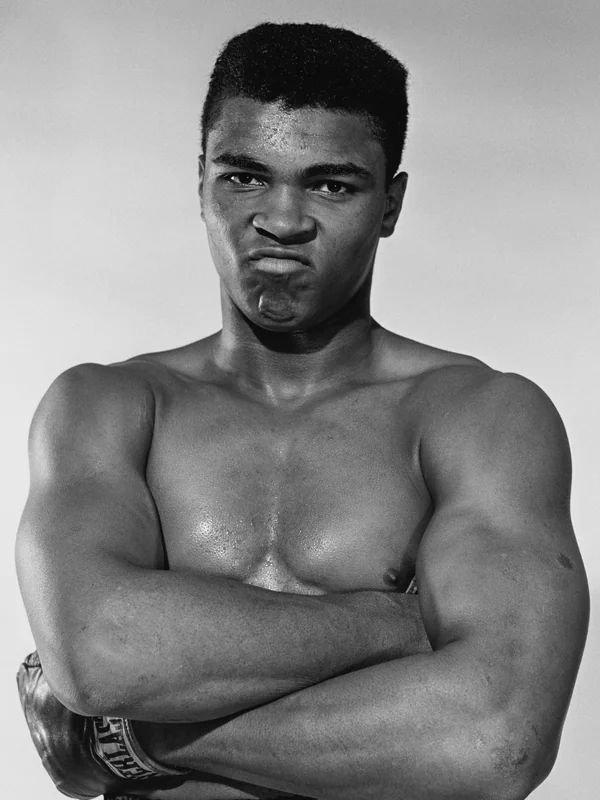
American boxer (1942–2016) who won Olympic gold in 1960 and became the first fighter to win the world heavyweight title three times, and a leading voice on race, religion and conscience.
Early Life
Muhammad Ali was born Cassius Marcellus Clay Jr. on 17 January 1942 in Louisville, Kentucky, in the segregated American South. His father, Cassius Marcellus Clay Sr., painted billboards and signs, and his mother, Odessa Grady Clay, worked as a household domestic. He grew up in a time of segregated public facilities and took up boxing at the age of 12, after his bicycle was stolen and the Louisville policeman Joe Martin suggested he learn to fight. He went on to win the national Golden Gloves and, at 18, the light-heavyweight gold medal at the 1960 Olympic Games in Rome.
Education
Ali attended Central High School in Louisville, Kentucky, graduating in 1958. He did not pursue university education; after the Rome Olympics he turned professional and boxing became his full-time career.
Career
Ali turned professional in October 1960 after winning Olympic gold in Rome, and built an unbeaten record that earned him a title fight against the feared champion Sonny Liston. On 25 February 1964 he won the world heavyweight championship when Liston failed to answer the bell for the seventh round, and days later he announced his new name, Muhammad Ali. In April 1967 he refused induction into the United States Army during the Vietnam War on religious grounds; he was convicted of draft evasion, stripped of his titles and boxing licences, and barred from the ring for more than three years. The United States Supreme Court unanimously overturned his conviction in June 1971. He lost his first professional fight to Joe Frazier in the 'Fight of the Century' in March 1971, beat Frazier in a 1974 rematch, and then regained the title by knocking out George Foreman in the eighth round in Kinshasa on 30 October 1974. He beat Frazier for a third time in the 'Thrilla in Manila' on 1 October 1975. After losing the title to Leon Spinks in February 1978, he won it back seven months later, becoming the first three-time heavyweight champion. He first retired in 1979, returned for two unsuccessful fights against Larry Holmes in 1980 and Trevor Berbick in 1981, and retired permanently in December 1981.
Achievements
Ali's achievements in the ring were unmatched in his era. He won the Olympic light-heavyweight gold medal in Rome in 1960, then took the world heavyweight title from Sonny Liston in 1964 at the age of 22. After losing more than three years of his career to his refusal to be inducted into the United States Army, he returned to win the title twice more: against George Foreman in the 'Rumble in the Jungle' in Kinshasa in 1974, and against Leon Spinks in 1978, becoming the first fighter to win the world heavyweight championship three times. He defended the title 19 times and finished with a professional record of 56 wins, 37 by knockout, and 5 defeats. Outside the ring he was named Sportsman of the Century by Sports Illustrated in 1999, lit the Olympic cauldron in Atlanta in 1996, and received the Presidential Medal of Freedom in 2005.
Legacy
Ali is remembered as one of the greatest boxers in history and as one of the most recognisable public figures of the twentieth century. His refusal to be inducted during the Vietnam War cost him the prime years of his career but made him a central figure in the civil rights and anti-war movements, and his later vindication by the Supreme Court is widely cited as a landmark for freedom of conscience. After his 1984 diagnosis of Parkinson's disease he became a prominent humanitarian, working for the Muhammad Ali Parkinson Center in Phoenix and travelling on diplomatic and charitable missions, including to Iraq in 1990. The Muhammad Ali Center opened in Louisville in 2005. He died on 3 June 2016 in Scottsdale, Arizona, aged 74, and was buried in Louisville after a funeral attended by world leaders, former opponents and thousands of fans.
Major Achievements
- Olympic light-heavyweight gold medallist at the Rome 1960 Olympic Games
- First boxer to win the world heavyweight championship on three separate occasions (1964, 1974, 1978)
- Successfully defended the world heavyweight title 19 times
- Won the 'Rumble in the Jungle' against George Foreman in Kinshasa, Zaire, on 30 October 1974, knocking out the undefeated champion in the eighth round
- Won the 'Thrilla in Manila' against Joe Frazier on 1 October 1975, one of the most celebrated fights in boxing history
- Final professional record of 56 wins (37 by knockout) and 5 defeats in 61 bouts
- Lit the Olympic cauldron at the Atlanta 1996 Olympic Games
- Presidential Medal of Freedom (2005), the highest civilian honour of the United States
- Named Sportsman of the Century by Sports Illustrated (1999) and Sports Personality of the Century by the BBC (1999)
Contributions
Ali changed what a sportsman could be in public life. In the ring he combined speed, footwork and showmanship in a way heavyweight boxing had not seen, and his 'rope-a-dope' tactics against Foreman in 1974 became part of sporting lore. Outside it, his public stand against the Vietnam War, his conversion to Islam and his refusal to accept his birth name as a 'slave name' forced American sport to confront race, religion and conscience. In later life his humanitarian work, his role as a United Nations Messenger of Peace and his dignified public life with Parkinson's disease extended his influence far beyond boxing, and his funeral in Louisville in 2016 was treated as a state occasion.
Notable Works
- The Greatest: My Own Story (1975, with Richard Durham)
- The Soul of a Butterfly: Reflections on Life's Journey (2004, with Hana Yasmeen Ali)
Milestones
- 1942 — Born Cassius Marcellus Clay Jr. on 17 January in Louisville, Kentucky Source: Encyclopaedia Britannica; Wikipedia
- 1954 — Began boxing at age 12 under Joe Martin Source: Encyclopaedia Britannica
- 1960 — Won the Olympic light-heavyweight gold medal at the Rome Olympic Games Source: Encyclopaedia Britannica; Wikipedia
- 1960 — Turned professional in October 1960 Source: Wikipedia (cross-checked)
- 1964 — Won the world heavyweight championship from Sonny Liston on 25 February 1964 Source: Encyclopaedia Britannica
- 1964 — Took the name Muhammad Ali on 6 March 1964 Source: Encyclopaedia Britannica
- 1967 — Refused induction into the United States Army; convicted of draft evasion and stripped of his titles and licences Source: Encyclopaedia Britannica
- 1971 — Lost the 'Fight of the Century' to Joe Frazier on 8 March 1971; the Supreme Court unanimously overturned his conviction later that year Source: Encyclopaedia Britannica; Wikipedia
- 1974 — Regained the heavyweight title by knocking out George Foreman in the eighth round in Kinshasa on 30 October 1974 ('Rumble in the Jungle') Source: Encyclopaedia Britannica
- 1975 — Beat Joe Frazier in the 'Thrilla in Manila' on 1 October 1975 Source: Encyclopaedia Britannica
- 1978 — Became the first fighter to win the world heavyweight championship three times, beating Leon Spinks on 15 September 1978 Source: Encyclopaedia Britannica
- 1981 — Retired permanently after his final fight against Trevor Berbick on 11 December 1981, with a record of 56 wins (37 knockouts) and 5 defeats Source: Encyclopaedia Britannica
- 1984 — Diagnosed with Parkinson's disease Source: Encyclopaedia Britannica
- 1996 — Lit the Olympic cauldron at the Atlanta Olympic Games on 19 July 1996 Source: Encyclopaedia Britannica; Ahram Online
- 1999 — Named Sportsman of the Century by Sports Illustrated and Sports Personality of the Century by the BBC Source: Wikipedia (cross-checked with BoxRec)
- 2005 — Received the Presidential Medal of Freedom; the Muhammad Ali Center opened in Louisville Source: Ahram Online; Encyclopaedia Britannica
- 2016 — Died on 3 June 2016 in Scottsdale, Arizona, aged 74 Source: Encyclopaedia Britannica; Wikipedia
Timeline
- 17 January 1942
Born Cassius Marcellus Clay Jr. in Louisville, Kentucky, United States
Source: Encyclopaedia Britannica; Wikipedia - 1954
Took up boxing at age 12 under Louisville policeman Joe Martin after his bicycle was stolen
Year only — exact date unknown Source: Encyclopaedia Britannica; Wikipedia - 5 September 1960
Won the Olympic light-heavyweight gold medal at the Rome Olympic Games
Source: Encyclopaedia Britannica; Wikipedia - 29 October 1960
Made his professional debut, beating Tunney Hunsaker on points in Louisville
Source: Wikipedia (cross-checked) - 25 February 1964
Won the world heavyweight championship from Sonny Liston in Miami Beach
Source: Encyclopaedia Britannica - 6 March 1964
Took the name Muhammad Ali, given to him by his spiritual mentor Elijah Muhammad
Source: Encyclopaedia Britannica - 1967
Refused induction into the United States Army; convicted of draft evasion and stripped of his titles and boxing licences
Year only — exact date unknown Source: Encyclopaedia Britannica; Wikipedia - 28 June 1971
The United States Supreme Court unanimously overturned his draft-evasion conviction in Clay v. United States
Source: Wikipedia (cross-checked with Britannica) - 30 October 1974
Knocked out George Foreman in the eighth round in Kinshasa, Zaire, in the 'Rumble in the Jungle' to regain the heavyweight title
Source: Encyclopaedia Britannica - 1 October 1975
Beat Joe Frazier in the 'Thrilla in Manila' when Frazier's corner stopped the fight after 14 rounds
Source: Encyclopaedia Britannica - 15 September 1978
Beat Leon Spinks on points to become the first three-time world heavyweight champion
Source: Encyclopaedia Britannica; Wikipedia - 11 December 1981
Lost his final fight, on points to Trevor Berbick in Nassau, and retired permanently with a record of 56 wins and 5 defeats
Source: Encyclopaedia Britannica - 1984
Diagnosed with Parkinson's disease
Year only — exact date unknown Source: Encyclopaedia Britannica; Muhammad Ali Center reporting - 19 July 1996
Lit the Olympic cauldron at the opening ceremony of the Atlanta Olympic Games
Source: Encyclopaedia Britannica; Ahram Online - 9 November 2005
Received the Presidential Medal of Freedom from President George W. Bush; the Muhammad Ali Center opened in Louisville the same year
Source: Ahram Online; Encyclopaedia Britannica - 3 June 2016
Died in Scottsdale, Arizona, aged 74, after respiratory complications
Source: Encyclopaedia Britannica; Wikipedia
Frequently Asked Questions
Who was Muhammad Ali?
Muhammad Ali (1942-2016) was an American professional boxer and social activist, widely regarded as one of the greatest heavyweights in history. Born Cassius Marcellus Clay Jr., he won Olympic gold in 1960 and became the first fighter to win the world heavyweight championship three times.
Source: Encyclopaedia Britannica; WikipediaHow many times did Muhammad Ali win the heavyweight title?
He won the world heavyweight title three times: from Sonny Liston in 1964, from George Foreman in the 'Rumble in the Jungle' in 1974, and from Leon Spinks in 1978. No fighter before him had won the heavyweight championship on three separate occasions.
Source: Encyclopaedia BritannicaWhy did Muhammad Ali lose his boxing titles in the 1960s?
In April 1967 Ali refused induction into the United States Army during the Vietnam War, citing his religious beliefs. He was convicted of draft evasion, stripped of his titles and licences, and unable to box for more than three years. In June 1971 the United States Supreme Court unanimously overturned his conviction.
Source: Encyclopaedia Britannica; WikipediaWhat was Muhammad Ali's professional boxing record?
Ali finished his professional career with 56 wins, 37 of them by knockout, and 5 defeats in 61 bouts. His final fight was a points defeat to Trevor Berbick on 11 December 1981.
Source: Encyclopaedia BritannicaWhat illness did Muhammad Ali have in later life?
He was diagnosed with Parkinson's disease in 1984, three years after retiring from boxing. He lived with the condition for 32 years, remaining active in humanitarian work, and died on 3 June 2016 in Scottsdale, Arizona, aged 74.
Source: Encyclopaedia Britannica; Muhammad Ali Center reportingSources & References
- Muhammad Ali — Encyclopaedia Britannica — Encyclopaedia Britannica (accessed 12 November 2026)
- Muhammad Ali — Wikipedia — Wikipedia (accessed 12 November 2026)
- Key dates in Muhammad Ali's life and career — Ahram Online — Ahram Online (accessed 12 November 2026)
- And Ali floats away — The Tribune — The Tribune (India) / Reuters (accessed 12 November 2026)
- File:Muhammad Ali portrait in Boxing Yearbook 1974.jpg — Wikimedia Commons (portrait file page) — Wikimedia Commons (accessed 12 November 2026)
