A. P. J. Abdul Kalam
Aerospace scientist · Science administrator · Author · Teacher
1931–2015 · Born in Rameswaram, Tamil Nadu, India · 4 min read
- Last verified: 12 November 2026
- Sources: 5
- Reviewed by Muse — Phase A coordinator (second review)
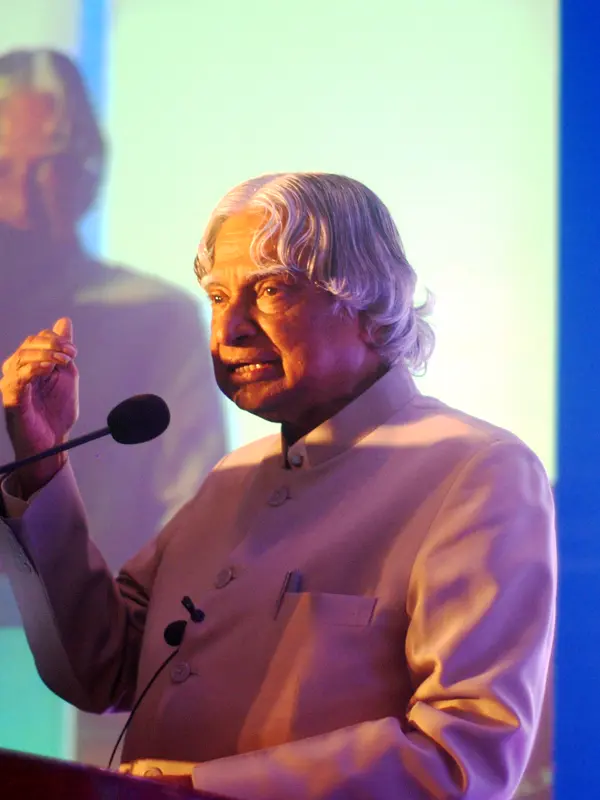
Indian aerospace scientist and the 11th President of India (2002–2007), known as the 'Missile Man' for leading India's SLV-III satellite launch vehicle and missile programmes.
Early Life
Avul Pakir Jainulabdeen Abdul Kalam was born on 15 October 1931 in Rameswaram, a pilgrimage town on Pamban Island, then in the Madras Presidency of British India and now in Tamil Nadu. He was the youngest of five children. His father, Jainulabdeen, owned boats and served as the imam of a local mosque, and his mother, Ashiamma, kept the home. The family had once been comfortable but was poor by the time Kalam was a boy, and he helped support it by delivering newspapers in the early morning before school. He was schooled at Schwartz Higher Secondary School in Ramanathapuram, where teachers described him as an average student who worked hard and spent long hours on mathematics.
Education
After school, Kalam studied physics at St. Joseph's College, Tiruchirappalli, then affiliated with the University of Madras, and graduated in 1954. His interest in flight drew him to engineering, and in 1955 he moved to Madras (now Chennai) to study aeronautical engineering at the Madras Institute of Technology. He graduated from the institute in 1960 with a degree in aeronautical engineering, the training that shaped the rest of his working life.
Career
After graduating in 1960, Kalam joined the Aeronautical Development Establishment of the Defence Research and Development Organisation (DRDO) as a scientist. In 1969 he moved to the Indian Space Research Organisation (ISRO), where he became project director of SLV-III, India's first satellite launch vehicle designed and built in the country. In 1982 he returned to DRDO and planned the Integrated Guided Missile Development Programme (IGMDP), under which the Agni and Prithvi missiles were developed. From July 1992 to December 1999 he was Scientific Adviser to the Defence Minister and Secretary of the Department of Defence Research and Development, and from November 1999 to November 2001 he served as Principal Scientific Adviser to the Government of India, with the rank of cabinet minister. In 2002 he was elected the 11th President of India and served one term, from 25 July 2002 to 25 July 2007. After the presidency he returned to teaching and lecturing, including as a visiting professor at Indian Institutes of Management, and served as the first Chancellor of the Indian Institute of Space Science and Technology (IIST), Thiruvananthapuram.
Achievements
Kalam's central achievement was building India's practical capacity to put satellites into orbit and to design its own missiles. As project director of SLV-III, he led the vehicle that placed the Rohini satellite in near-Earth orbit in July 1980, a step that put India among the small number of countries able to launch their own satellites. Through the IGMDP he led the development and operational use of the Agni intermediate-range ballistic missile, first launched in 1989, and the Prithvi surface-to-surface missile. He was one of the chief coordinators of the Pokhran-II nuclear tests in May 1998, in which five devices were detonated, and he put forward Technology Vision 2020 the same year, a plan for turning India into a developed country within twenty years through agriculture, technology, health care and education. As President he was widely called the 'People's President' for his direct engagement with students and young people. His honours included the Padma Bhushan in 1981, the Padma Vibhushan in 1990 and the Bharat Ratna, India's highest civilian honour, in 1997.
Legacy
Kalam is remembered in India as the scientist who carried the country's space and missile programmes from dependence to self-reliance, and as a president who used the office to speak to students rather than to politics. His autobiography, Wings of Fire (1999), became one of India's most widely read memoirs and is still used in schools. After his death, a missile test site in Odisha was renamed Abdul Kalam Island in 2015, and in 2017 a bacterium found on the International Space Station was named Solibacillus kalamii in his honour. He died on 27 July 2015, aged 83, after collapsing from cardiac arrest while delivering a lecture at the Indian Institute of Management Shillong, and was buried with full state honours at Pei Karumbu ground in his home town of Rameswaram on 30 July 2015.
Major Achievements
- Project director of SLV-III, India's first indigenously designed and built satellite launch vehicle, which placed the Rohini satellite in near-Earth orbit in July 1980
- Chief executive of the Integrated Guided Missile Development Programme (IGMDP), leading the development and operationalisation of the Agni and Prithvi missiles
- One of the chief coordinators of the Pokhran-II nuclear tests in May 1998
- Author of Technology Vision 2020 (1998), a national plan for developing India through technology, agriculture, health care and education
- 11th President of India, 25 July 2002 to 25 July 2007, widely known as the 'People's President'
- First Chancellor of the Indian Institute of Space Science and Technology (IIST), Thiruvananthapuram
- Bharat Ratna (1997), India's highest civilian honour; Padma Vibhushan (1990); Padma Bhushan (1981)
- Author of the autobiography Wings of Fire (1999), Ignited Minds (2002) and India 2020: A Vision for the New Millennium (1998)
Contributions
Kalam's work joined two strands of India's modern history: the civilian space programme and the defence missile programme. At ISRO he turned the SLV-III project into a working launch capability and helped shape the later Polar Satellite Launch Vehicle programme. At DRDO he built the institutional programme, the IGMDP, that produced India's Agni and Prithvi missiles and the domestic engineering base behind them. In government he coordinated the weaponisation work around the Pokhran-II tests and set out, in Technology Vision 2020, a practical argument that technology, farming, health and education together could lift India to developed-country status. As President and afterwards as a teacher, he carried that argument directly to students across the country.
Notable Works
- Wings of Fire: An Autobiography (1999)
- India 2020: A Vision for the New Millennium (1998)
- Ignited Minds: Unleashing the Power Within India (2002)
- My Journey: Transforming Dreams into Actions (2013)
Milestones
- 1931 — Born on 15 October in Rameswaram, Tamil Nadu Source: Encyclopaedia Britannica; President of India
- 1954 — Graduated in physics from St. Joseph's College, Tiruchirappalli Source: Wikipedia (cross-checked); Encyclopaedia Britannica
- 1960 — Graduated in aeronautical engineering from the Madras Institute of Technology and joined the Aeronautical Development Establishment of DRDO as a scientist Source: Encyclopaedia Britannica; Wikipedia
- 1969 — Transferred to ISRO and became project director of SLV-III, India's first satellite launch vehicle Source: Encyclopaedia Britannica; President of India
- 1980 — SLV-III successfully placed the Rohini satellite in near-Earth orbit in July 1980 Source: Encyclopaedia Britannica; President of India
- 1982 — Rejoined DRDO and planned the Integrated Guided Missile Development Programme (IGMDP) Source: Encyclopaedia Britannica
- 1989 — Agni, India's first intermediate-range ballistic missile, first launched Source: Encyclopaedia Britannica
- 1992 — Became Scientific Adviser to the Defence Minister and Secretary, Department of Defence Research and Development (served July 1992 to December 1999) Source: President of India; Encyclopaedia Britannica
- 1997 — Awarded the Bharat Ratna, India's highest civilian honour Source: President of India; Encyclopaedia Britannica
- 1998 — One of the chief coordinators of the Pokhran-II nuclear tests in May 1998; put forward Technology Vision 2020 Source: Encyclopaedia Britannica; President of India
- 1999 — Became Principal Scientific Adviser to the Government of India, with the rank of cabinet minister (November 1999 to November 2001) Source: President of India; Encyclopaedia Britannica
- 2002 — Sworn in as the 11th President of India on 25 July 2002 Source: President of India; Encyclopaedia Britannica
- 2007 — Left the presidency on 25 July 2007; became the first Chancellor of the Indian Institute of Space Science and Technology (IIST) Source: Encyclopaedia Britannica; Wikipedia (IIST)
- 2015 — Died on 27 July 2015 in Shillong, aged 83, after collapsing while lecturing at the Indian Institute of Management Shillong; buried with full state honours in Rameswaram on 30 July 2015 Source: Encyclopaedia Britannica; The Hindu
Timeline
- 15 October 1931
Born in Rameswaram, Tamil Nadu (then Madras Presidency, British India)
Source: Encyclopaedia Britannica; President of India - 1954
Graduated in physics from St. Joseph's College, Tiruchirappalli
Year only — exact date unknown Source: Wikipedia (cross-checked) - 1960
Graduated in aeronautical engineering from the Madras Institute of Technology; joined DRDO as a scientist
Year only — exact date unknown Source: Encyclopaedia Britannica; Wikipedia - 1969
Transferred to ISRO; became project director of SLV-III
Year only — exact date unknown Source: Encyclopaedia Britannica; President of India - 1980
SLV-III placed the Rohini satellite in near-Earth orbit
Year only — exact date unknown Source: Encyclopaedia Britannica; President of India - 1982
Rejoined DRDO; planned the Integrated Guided Missile Development Programme
Year only — exact date unknown Source: Encyclopaedia Britannica - 1997
Awarded the Bharat Ratna
Year only — exact date unknown Source: President of India; Encyclopaedia Britannica - 1998
Pokhran-II nuclear tests; Technology Vision 2020 put forward
Year only — exact date unknown Source: Encyclopaedia Britannica - 25 July 2002
Sworn in as the 11th President of India
Source: President of India; Encyclopaedia Britannica - 25 July 2007
Left the presidency at the end of his term
Source: Encyclopaedia Britannica; Wikipedia - 27 July 2015
Died in Shillong, Meghalaya, from cardiac arrest while lecturing at the Indian Institute of Management Shillong
Source: Encyclopaedia Britannica; The Hindu - 30 July 2015
Buried with full state honours at Pei Karumbu ground, Rameswaram
Source: Wikipedia (cross-checked with The Hindu obituary reporting of the funeral)
Related Personalities
Frequently Asked Questions
Who was A. P. J. Abdul Kalam?
A. P. J. Abdul Kalam (1931–2015) was an Indian aerospace scientist and the 11th President of India (2002–2007). Before becoming President, he spent four decades at DRDO and ISRO, leading India's satellite launch vehicle and missile programmes.
Source: Encyclopaedia Britannica; President of IndiaWhy was Abdul Kalam called the 'Missile Man' of India?
He earned the name for his work on ballistic missile and launch vehicle technology, above all as chief executive of the Integrated Guided Missile Development Programme, which developed the Agni and Prithvi missiles, and as project director of the SLV-III launch vehicle.
Source: Encyclopaedia Britannica; President of IndiaWhen was Abdul Kalam President of India?
He was sworn in as the 11th President of India on 25 July 2002 and served one term, leaving office on 25 July 2007. He was succeeded by Pratibha Patil.
Source: President of India; Encyclopaedia BritannicaWhat awards did Abdul Kalam receive?
He received India's three highest civilian honours in turn: the Padma Bhushan in 1981, the Padma Vibhushan in 1990 and the Bharat Ratna, India's highest civilian honour, in 1997.
Source: President of India; Encyclopaedia BritannicaHow did Abdul Kalam die?
He died on 27 July 2015, aged 83, in Shillong, Meghalaya, after collapsing from cardiac arrest while delivering a lecture at the Indian Institute of Management Shillong. He was buried with full state honours in his home town of Rameswaram on 30 July 2015.
Source: Encyclopaedia Britannica; The HinduSources & References
- A.P.J. Abdul Kalam — Encyclopaedia Britannica — Encyclopaedia Britannica (accessed 12 November 2026)
- DR. A.P.J. Abdul Kalam — President of India (official profile) — President of India, Government of India (accessed 12 November 2026)
- A. P. J. Abdul Kalam — Wikipedia — Wikipedia (accessed 12 November 2026)
- Former President A.P.J. Abdul Kalam passes away — The Hindu — The Hindu (accessed 12 November 2026)
- File:A.P.J Abdul Kalam.jpg — Wikimedia Commons (portrait file page) — Wikimedia Commons (accessed 12 November 2026)
