Albert Einstein
Theoretical physicist · Professor
1879–1955 · Born in Ulm, Kingdom of Württemberg, German Empire (now Germany) · 4 min read
- Last verified: 12 November 2026
- Sources: 5
- Reviewed by Muse — Phase C second review (independent check)
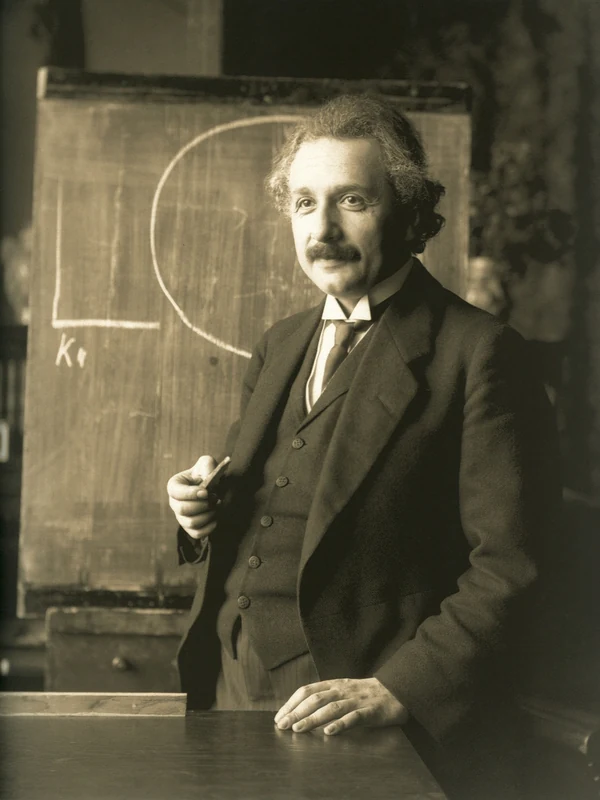
German-born physicist who developed the special and general theories of relativity and won the 1921 Nobel Prize in Physics for the photoelectric effect.
Early Life
Albert Einstein was born on 14 March 1879 in Ulm, in the Kingdom of Württemberg in the German Empire, the elder child of Hermann Einstein, who ran an electrical engineering business, and Pauline Koch. The family moved to Munich when he was a year old, and to Italy in 1894 when his father's business failed. He was a slow developer as a small child and disliked the rigid discipline of his Munich school, but he taught himself mathematics and physics, including calculus, before he was sixteen. In 1895 he failed the entrance examination for the Swiss Federal Polytechnic in Zurich — passing mathematics and physics but not the other subjects — and finished secondary school in Aarau, Switzerland, before enrolling at the Polytechnic in 1896.
Education
Einstein studied mathematics and physics at the Swiss Federal Polytechnic School in Zurich (now ETH Zurich) from 1896 to 1900, graduating with a teaching diploma. His fellow students included Marcel Grossmann and Michele Besso, and his future first wife, Mileva Marić, a Serbian physics student. In 1905 the University of Zurich accepted his doctoral dissertation, 'A New Determination of Molecular Dimensions'. He renounced his German citizenship in 1896, was stateless for some years, and became a Swiss citizen in 1901.
Career
After graduating from the Swiss Federal Polytechnic in Zurich in 1900, Einstein could not find a university post and supported himself with temporary teaching work. In June 1902 he became a technical examiner at the Swiss Patent Office in Bern, a post he held until 1909, doing his physics in his spare time. Recognition came quickly after 1905: associate professor at the University of Zurich in 1909, full professor at the German University of Prague in 1911, professor at the ETH Zurich in 1912, and in 1914 a member of the Prussian Academy of Sciences in Berlin, where he also directed the Kaiser Wilhelm Institute for Physics from 1917. He was visiting the United States when the Nazis took power in January 1933; he did not return to Germany, resigned from the Prussian Academy, and in October 1933 joined the newly founded Institute for Advanced Study in Princeton, New Jersey, where he worked for the rest of his life. He became a citizen of the United States in 1940 while retaining his Swiss citizenship.
Achievements
Einstein's central achievement was rebuilding physics on new foundations. In 1905, while working as a patent examiner in Bern, he published four papers in the journal Annalen der Physik: one explaining the photoelectric effect by treating light as packets of energy, one explaining Brownian motion as evidence for atoms, one introducing special relativity, and a short paper deriving the mass-energy equivalence expressed as E = mc². Ten years later he completed the general theory of relativity, presenting its field equations to the Prussian Academy of Sciences on 25 November 1915. The theory predicted that starlight would bend near the Sun, and eclipse expeditions on 29 May 1919 measured the bending as predicted, making Einstein world-famous overnight. He received the 1921 Nobel Prize in Physics for the photoelectric effect — not for relativity, which was still contested. His later work, including the 1935 Einstein-Podolsky-Rosen paper, shaped the interpretation of quantum mechanics, and his 1939 letter to President Roosevelt helped set the Manhattan Project in motion.
Legacy
Einstein is generally considered the most influential physicist of the twentieth century. Special and general relativity replaced Newton's picture of absolute space and time with spacetime curved by mass and energy, and his explanation of the photoelectric effect helped found quantum theory; both underpin modern physics, from GPS navigation, which must correct for relativistic effects, to cosmology. He also became the most visible scientist of his age: a refugee from Nazi Germany, an outspoken critic of militarism and racism, a supporter of Jewish cultural institutions and an advocate of international cooperation. He died in Princeton on 18 April 1955, aged 76, of an abdominal aortic aneurysm. In 1999 Time magazine named him Person of the Century.
Major Achievements
- Published four landmark papers in 1905 — his annus mirabilis — on the photoelectric effect, Brownian motion, special relativity and mass-energy equivalence
- Formulated the special theory of relativity (1905) and the general theory of relativity (1915), describing gravity as the curvature of spacetime
- Awarded the 1921 Nobel Prize in Physics for his explanation of the photoelectric effect (prize presented in 1922)
- Predicted the bending of starlight by gravity, confirmed by the solar eclipse expeditions of 29 May 1919, which made him world-famous
- Co-authored the Einstein-Podolsky-Rosen paper (1935), which framed the debate over quantum entanglement
- Signed the 1939 letter to President Franklin D. Roosevelt warning that Germany might be developing an atomic bomb
- Named Time magazine's Person of the Century in 1999
Contributions
Einstein's work joined three strands of physics that had seemed separate: light, motion and gravity. Special relativity showed that space and time are not absolute but depend on the observer's motion, and that mass and energy are equivalent. General relativity went further, describing gravity not as a force acting at a distance, as Newton had conceived it, but as the curvature of spacetime caused by mass and energy — a prediction confirmed by the bending of starlight in 1919 and, a century later, by the direct detection of gravitational waves. His 1905 paper on light quanta, for which he won the Nobel Prize, treated light as discrete packets of energy and laid a foundation of quantum theory, even though he remained uneasy about the theory's probabilistic interpretation for the rest of his life.
Notable Works
- On the Electrodynamics of Moving Bodies (1905)
- Does the Inertia of a Body Depend Upon Its Energy Content? (1905)
- The Foundation of the General Theory of Relativity (1916)
- Relativity: The Special and the General Theory (1916)
- The Meaning of Relativity (1922)
- The Evolution of Physics (1938, with Leopold Infeld)
Milestones
- 1879 — Born on 14 March in Ulm, Kingdom of Württemberg, German Empire Source: NobelPrize.org; Encyclopaedia Britannica
- 1896 — Enrolled at the Swiss Federal Polytechnic School in Zurich; renounced German citizenship Source: Encyclopaedia Britannica
- 1900 — Graduated from the Swiss Federal Polytechnic with a teaching diploma Source: Encyclopaedia Britannica
- 1901 — Became a Swiss citizen Source: Encyclopaedia Britannica
- 1902 — Began work as a technical examiner at the Swiss Patent Office in Bern Source: Encyclopaedia Britannica
- 1905 — Annus mirabilis: four landmark papers in Annalen der Physik; doctorate from the University of Zurich Source: NobelPrize.org; Encyclopaedia Britannica
- 1909 — Left the patent office for a professorship at the University of Zurich Source: Encyclopaedia Britannica
- 1914 — Moved to Berlin as a member of the Prussian Academy of Sciences Source: Encyclopaedia Britannica
- 1915 — Presented the field equations of general relativity Source: Encyclopaedia Britannica
- 1919 — Solar eclipse expeditions confirmed the bending of starlight predicted by general relativity Source: Encyclopaedia Britannica
- 1922 — Awarded the 1921 Nobel Prize in Physics for the photoelectric effect (presented in 1922) Source: NobelPrize.org
- 1933 — Left Germany and joined the Institute for Advanced Study in Princeton Source: Encyclopaedia Britannica
- 1939 — Signed the letter to President Roosevelt warning of a possible German atomic bomb programme Source: Encyclopaedia Britannica; Wikipedia
- 1940 — Became a citizen of the United States, retaining Swiss citizenship Source: Encyclopaedia Britannica
- 1955 — Died in Princeton, New Jersey, aged 76 Source: Encyclopaedia Britannica
Timeline
- 14 March 1879
Born in Ulm, Kingdom of Württemberg, German Empire
Source: NobelPrize.org; Encyclopaedia Britannica - 1896
Enrolled at the Swiss Federal Polytechnic School in Zurich; renounced German citizenship
Year only — exact date unknown Source: Encyclopaedia Britannica - 1900
Graduated from the Swiss Federal Polytechnic with a teaching diploma in mathematics and physics
Year only — exact date unknown Source: Encyclopaedia Britannica - 1901
Became a Swiss citizen
Year only — exact date unknown Source: Encyclopaedia Britannica - 1902
Began work as a technical examiner at the Swiss Patent Office in Bern
Year only — exact date unknown Source: Encyclopaedia Britannica - 1903
Married Mileva Marić, a fellow physics student from Zurich
Year only — exact date unknown Source: Encyclopaedia Britannica - 1905
Annus mirabilis: published four landmark papers in Annalen der Physik and received his doctorate from the University of Zurich
Year only — exact date unknown Source: NobelPrize.org; Encyclopaedia Britannica - 1909
Left the patent office to become associate professor at the University of Zurich
Year only — exact date unknown Source: Encyclopaedia Britannica - 1914
Moved to Berlin as a member of the Prussian Academy of Sciences
Year only — exact date unknown Source: Encyclopaedia Britannica - 25 November 1915
Presented the final form of the field equations of general relativity to the Prussian Academy of Sciences
Source: Encyclopaedia Britannica - 29 May 1919
Solar eclipse expeditions confirmed the bending of starlight predicted by general relativity
Source: Encyclopaedia Britannica - 1922
Awarded the 1921 Nobel Prize in Physics for the photoelectric effect (prize presented in 1922)
Year only — exact date unknown Source: NobelPrize.org - 1933-10
Joined the Institute for Advanced Study in Princeton, New Jersey, after leaving Germany
Approximate date Source: Encyclopaedia Britannica - 2 August 1939
Signed the letter to President Franklin D. Roosevelt warning that Germany might be pursuing an atomic bomb
Source: Encyclopaedia Britannica; Wikipedia - 1940
Became a citizen of the United States, retaining Swiss citizenship
Year only — exact date unknown Source: Encyclopaedia Britannica - 18 April 1955
Died in Princeton, New Jersey, aged 76, of an abdominal aortic aneurysm
Source: Encyclopaedia Britannica
Related Personalities
Frequently Asked Questions
Who was Albert Einstein?
Albert Einstein (1879–1955) was a German-born theoretical physicist who developed the special and general theories of relativity and won the 1921 Nobel Prize in Physics for his explanation of the photoelectric effect. He is generally considered the most influential physicist of the twentieth century.
Source: Encyclopaedia Britannica; NobelPrize.orgWhat did Einstein publish in his miracle year of 1905?
In 1905, his 'miracle year' (annus mirabilis), Einstein published four papers in the journal Annalen der Physik: on the photoelectric effect, on Brownian motion, on special relativity, and on mass-energy equivalence, which produced the formula E = mc².
Source: NobelPrize.org; Encyclopaedia BritannicaWhy did Einstein win the Nobel Prize?
He won the 1921 Nobel Prize in Physics 'for his services to Theoretical Physics, and especially for his discovery of the law of the photoelectric effect'. The prize was reserved in 1921 and awarded to him in 1922. It was not awarded for relativity, which was still contested at the time.
Source: NobelPrize.orgHow was general relativity confirmed?
General relativity predicts that gravity bends light. During the total solar eclipse of 29 May 1919, expeditions led by Arthur Eddington measured the bending of starlight near the Sun and found it matched Einstein's prediction, confirming the theory and making him world-famous.
Source: Encyclopaedia BritannicaWhy did Einstein move to the United States?
Einstein was visiting the United States when the Nazis took power in January 1933. He did not return to Germany, resigned from the Prussian Academy of Sciences, and in October 1933 joined the Institute for Advanced Study in Princeton, New Jersey, where he lived and worked until his death in 1955. He became a US citizen in 1940.
Source: Encyclopaedia BritannicaSources & References
- Albert Einstein — Facts (Nobel Prize in Physics 1921) — NobelPrize.org (accessed 12 November 2026)
- Albert Einstein — Encyclopaedia Britannica — Encyclopaedia Britannica (accessed 12 November 2026)
- Albert Einstein — Questions and answers — NobelPrize.org (accessed 12 November 2026)
- Albert Einstein — Wikipedia (cross-check) — Wikipedia (accessed 12 November 2026)
- File:Einstein 1921 by F Schmutzer - restoration.jpg — Wikimedia Commons (portrait file page) — Wikimedia Commons (accessed 12 November 2026)
