Marie Curie
Physicist and chemist · Physicist · Chemist · Professor
1867–1934 · Born in Warsaw, Congress Kingdom of Poland, Russian Empire (now Poland) · 4 min read
- Last verified: 12 November 2026
- Sources: 5
- Reviewed by Muse — Phase C second review (independent check)
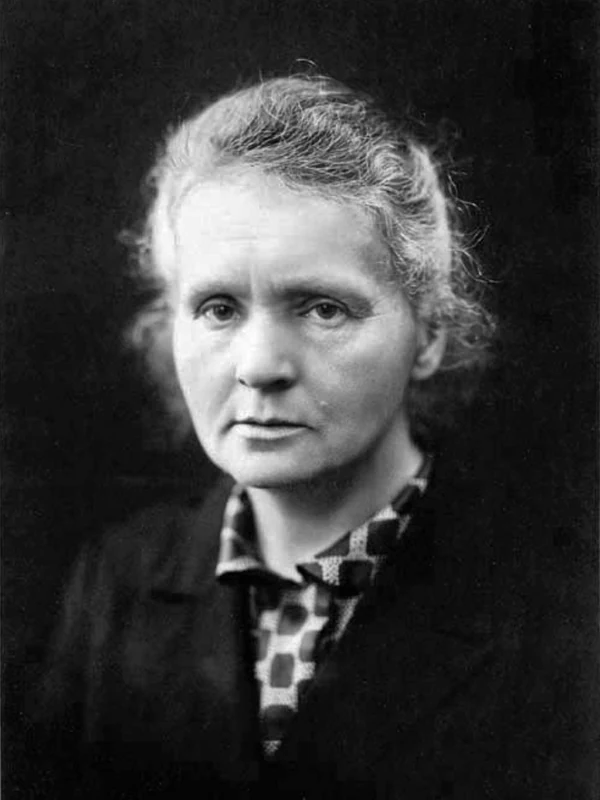
Polish-born French physicist and chemist who discovered polonium and radium and remains the only person to win Nobel Prizes in two different sciences.
Early Life
Marie Curie was born Maria Salomea Skłodowska on 7 November 1867 in Warsaw, then in the part of Poland ruled by the Russian Empire, the fifth and youngest child of Władysław Skłodowski and Bronisława Boguska, both teachers. Her father taught mathematics and physics, and her mother ran a girls' school. Poland was under Russian rule, and higher education for women was restricted, so after finishing school she studied in secret at the clandestine 'Flying University' in Warsaw and worked for several years as a governess and tutor to save money for study abroad. In 1891 she moved to Paris and enrolled at the Sorbonne, signing her name in its French form, Marie.
Education
Curie received her early education in Warsaw, including secret classes at the Flying University, which provided higher education to women under Russian rule. At the Sorbonne in Paris she studied physics and mathematics, earning a degree in physics in 1893 and in mathematics in 1894. She received her Doctor of Science degree from the Sorbonne in 1903 for her thesis on radioactive substances, the first doctorate awarded to a woman in France.
Career
After moving to Paris in 1891, Curie studied physics and mathematics at the Sorbonne, taking degrees in both subjects by 1894. She met the physicist Pierre Curie in 1894 and married him on 26 July 1895. She began her doctoral research on Becquerel's rays in 1897 and defended her thesis, Recherches sur les substances radioactives, on 25 June 1903, becoming the first woman in France to receive a doctoral degree. After Pierre's death in a road accident on 19 April 1906, she succeeded him as head of the physics laboratory and, on 13 May 1906, took his chair as Professor of General Physics at the Sorbonne — the first woman to hold a professorship there. She directed the Radium Institute in Paris, whose building was completed in 1914, and after the First World War led it as a centre for research and cancer treatment; a sister institute in Warsaw, directed by her sister Bronisława, opened in 1932. She continued to direct research in Paris until her death in 1934.
Achievements
Curie's central achievement was the science of radioactivity. Working with her husband Pierre in a shed at the School of Physics in Paris, she showed that the radiation discovered by Henri Becquerel in uranium was a property of the atom itself, coined the term radioactivity, and found the phenomenon in thorium as well. Searching pitchblende for the source of its unexpectedly strong radiation, the Curies announced two new elements in 1898: polonium, named after her native Poland, in July, and radium in December. She isolated radium as a pure metal in 1910. For this work she won the 1903 Nobel Prize in Physics, shared with Pierre and Becquerel, becoming the first woman to win a Nobel Prize, and the 1911 Nobel Prize in Chemistry alone, making her the only person to win Nobel Prizes in two different sciences. During the First World War she put the same science to medical use, building mobile X-ray units that examined over a million wounded soldiers.
Legacy
Curie remains the only person to win Nobel Prizes in two different sciences and the first woman to win a Nobel Prize at all. Her work founded the study of radioactivity and opened the way to nuclear physics, radiochemistry and radiation medicine; the element curium is named after Marie and Pierre Curie. She also changed who could be a scientist: the first woman professor at the Sorbonne, she trained a generation of researchers, including her daughter Irène Joliot-Curie, who won the Nobel Prize in Chemistry in 1935 with her husband Frédéric Joliot. She died on 4 July 1934 near Sallanches, France, of aplastic anaemia, a blood disorder linked to her decades of exposure to radiation. In 1995 her remains, together with Pierre's, were moved to the Panthéon in Paris, making her the first woman honoured there for her own achievements.
Major Achievements
- Discovered the elements polonium (July 1898) and radium (December 1898) with her husband Pierre Curie
- Coined the term radioactivity and developed the theory of radioactive decay
- Shared the 1903 Nobel Prize in Physics with Pierre Curie and Henri Becquerel — the first woman to win a Nobel Prize
- Won the 1911 Nobel Prize in Chemistry alone, for the discovery of radium and polonium and the isolation of radium — the only person to win Nobel Prizes in two different sciences
- Became the first woman professor at the Sorbonne in 1906, succeeding her husband's chair after his death
- Developed mobile X-ray units, the 'petites Curies', in the First World War, with some 20 vehicles and about 200 radiology posts examining over a million wounded soldiers
- Founded the Radium Institute in Paris (completed 1914), which became a leading centre for research and cancer treatment
- In 1995 became the first woman honoured in the Panthéon in Paris on her own merits, when her remains were moved there with Pierre Curie's
Contributions
Curie's contribution was to turn a puzzling observation — Becquerel's rays — into a new science. She showed that radioactivity was an atomic property, not a chemical one; she devised precise methods for measuring it; she used those methods to discover two new elements; and she developed the techniques for isolating radioactive isotopes in pure form. The same work had immediate medical consequences: radium became a treatment for cancer, and in the First World War her mobile X-ray units brought diagnosis to the battlefield. Her Radium Institute in Paris, and its sister institute in Warsaw, carried that combination of research and treatment into the next generation.
Notable Works
- Recherches sur les substances radioactives (doctoral thesis, 1903)
- Traité de radioactivité (Treatise on Radioactivity, 1910)
- Radium and the New Concepts in Chemistry (Nobel Lecture, 1911)
- Pierre Curie (biography, 1923)
Milestones
- 1867 — Born Maria Salomea Skłodowska in Warsaw, then in the Russian Empire Source: NobelPrize.org; Encyclopaedia Britannica
- 1891 — Moved to Paris and enrolled at the Sorbonne Source: NobelPrize.org; Encyclopaedia Britannica
- 1893 — Earned degrees in physics (1893) and mathematics (1894) at the Sorbonne Source: Encyclopaedia Britannica
- 1895 — Married the physicist Pierre Curie Source: Encyclopaedia Britannica
- 1898 — Announced the discovery of polonium in July and radium in December, with Pierre Curie Source: NobelPrize.org; Encyclopaedia Britannica
- 1903 — Defended her doctoral thesis on radioactive substances; awarded the Nobel Prize in Physics, shared with Pierre Curie and Henri Becquerel Source: NobelPrize.org
- 1906 — Pierre Curie died in a road accident; Marie succeeded him as Professor of General Physics at the Sorbonne, the first woman to hold a professorship there Source: Encyclopaedia Britannica
- 1911 — Awarded the Nobel Prize in Chemistry alone, for the discovery of radium and polonium and the isolation of radium Source: NobelPrize.org
- 1914 — The Radium Institute in Paris was completed; developed mobile X-ray units during the First World War Source: Encyclopaedia Britannica; NobelPrize.org
- 1932 — A sister Radium Institute opened in Warsaw Source: Encyclopaedia Britannica
- 1934 — Died near Sallanches, France, aged 66 Source: Encyclopaedia Britannica; NobelPrize.org
- 1995 — Her remains were moved to the Panthéon in Paris, the first woman honoured there on her own merits Source: Encyclopaedia Britannica
Timeline
- 7 November 1867
Born Maria Salomea Skłodowska in Warsaw, then in the Russian Empire
Source: NobelPrize.org; Encyclopaedia Britannica - 1891
Moved to Paris and enrolled at the Sorbonne (University of Paris)
Year only — exact date unknown Source: NobelPrize.org; Encyclopaedia Britannica - 26 July 1895
Married the physicist Pierre Curie in a civil ceremony at Sceaux
Source: Encyclopaedia Britannica - 1898-07
Announced the discovery of polonium, named after her native Poland
Approximate date Source: NobelPrize.org; Encyclopaedia Britannica - 26 December 1898
Announced the discovery of radium with Pierre Curie
Source: NobelPrize.org - 25 June 1903
Defended her doctoral thesis on radioactive substances at the Sorbonne, the first woman in France to receive a doctoral degree
Source: NobelPrize.org - 10 December 1903
Awarded the Nobel Prize in Physics, shared with Pierre Curie and Henri Becquerel — the first woman to win a Nobel Prize
Source: NobelPrize.org - 19 April 1906
Pierre Curie died in a road accident in Paris
Source: Encyclopaedia Britannica - 13 May 1906
Succeeded Pierre Curie as Professor of General Physics at the Sorbonne, the first woman to hold a professorship there
Source: Encyclopaedia Britannica - 1911
Awarded the Nobel Prize in Chemistry alone, for the discovery of radium and polonium and the isolation of radium
Year only — exact date unknown Source: NobelPrize.org - 1914
The Radium Institute in Paris was completed; the First World War began and she developed mobile X-ray units
Year only — exact date unknown Source: Encyclopaedia Britannica; NobelPrize.org - 1932
A sister Radium Institute opened in Warsaw, directed by her sister Bronisława
Year only — exact date unknown Source: Encyclopaedia Britannica - 4 July 1934
Died near Sallanches, France, aged 66, of aplastic anaemia linked to radiation exposure
Source: Encyclopaedia Britannica; NobelPrize.org - 1995
Her remains, with Pierre Curie's, were moved to the Panthéon in Paris — the first woman honoured there on her own merits
Year only — exact date unknown Source: Encyclopaedia Britannica
Related Personalities
Frequently Asked Questions
Who was Marie Curie?
Marie Curie (1867–1934), born Maria Skłodowska in Warsaw, was a Polish-born French physicist and chemist who pioneered research on radioactivity. She discovered the elements polonium and radium, coined the term radioactivity, and remains the only person to win Nobel Prizes in two different sciences.
Source: NobelPrize.org; Encyclopaedia BritannicaWhat elements did Marie Curie discover?
Polonium and radium. Working with her husband Pierre Curie, she announced polonium in July 1898, naming it after her native Poland, and radium in December 1898. Both were found by chemical separation of pitchblende, an ore rich in uranium.
Source: NobelPrize.org; Encyclopaedia BritannicaHow many Nobel Prizes did Marie Curie win?
Two: the Nobel Prize in Physics in 1903, shared with her husband Pierre Curie and Henri Becquerel, for their research on radiation — making her the first woman to win a Nobel Prize — and the Nobel Prize in Chemistry in 1911, awarded to her alone, for the discovery of radium and polonium and the isolation of radium. She is the only person to win Nobel Prizes in two different sciences.
Source: NobelPrize.orgWhat did Marie Curie do during the First World War?
During the First World War she developed mobile X-ray units, nicknamed the 'petites Curies', so that surgeons near the front could locate bullets and shrapnel in wounded men. She organised about 20 mobile units and some 200 fixed radiology posts, trained women — including her daughter Irène — to operate them, and drove a unit to the front herself. Over a million wounded soldiers were examined with the service she organised.
Source: NobelPrize.org; Encyclopaedia BritannicaHow did Marie Curie die?
She died on 4 July 1934 near Sallanches, France, aged 66, of aplastic anaemia, a blood disorder linked to her decades of exposure to radiation from her scientific work and her wartime X-ray units. In 1995 her remains were moved to the Panthéon in Paris, making her the first woman honoured there for her own achievements.
Source: Encyclopaedia Britannica; NobelPrize.orgSources & References
- Marie Curie — Biographical (Nobel Prize in Physics 1903) — NobelPrize.org (accessed 12 November 2026)
- Marie Curie — Encyclopaedia Britannica — Encyclopaedia Britannica (accessed 12 November 2026)
- Marie Curie — Facts (Nobel Prize in Physics 1903) — NobelPrize.org (accessed 12 November 2026)
- Marie Curie — Wikipedia (cross-check) — Wikipedia (accessed 12 November 2026)
- File:Marie Curie c1920.jpg — Wikimedia Commons (portrait file page) — Wikimedia Commons (accessed 12 November 2026)
