Charles Dickens
Novelist · Writer · Journalist
1812–1870 · Born in Portsmouth, Hampshire, England · 3 min read
- Last verified: 12 November 2026
- Sources: 4
- Reviewed by Muse — Phase D second review (independent check)
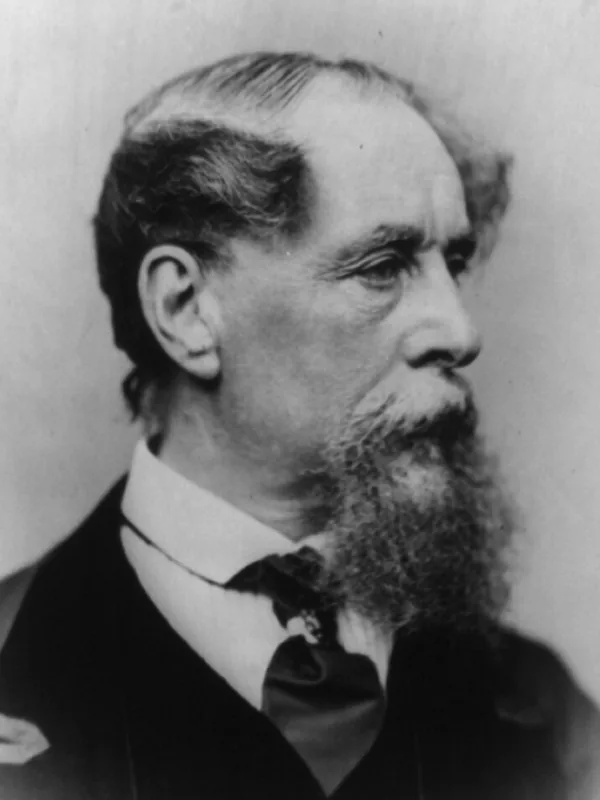
English novelist (1812–1870), generally considered the greatest novelist of the Victorian era, whose serialised novels — Oliver Twist, David Copperfield, A Tale of Two Cities, Great Expectations — mixed comedy, social criticism and unforgettable characters.
Early Life
Charles John Huffam Dickens was born on 7 February 1812 at Portsmouth, the second of eight children of John Dickens, a clerk in the Navy Pay Office, and Elizabeth Barrow. The family moved to London in 1815 and to Chatham, Kent, in 1817, where the boy spent some of the happiest years of his childhood. In 1824 his father was imprisoned in the Marshalsea debtors' prison in Southwark, and Charles, aged 12, was put to work pasting labels on bottles of blacking at Warren's factory in London for 10-hour days, six shillings a week. The experience — the shame of it, the debtors' prison, the child labour — stayed with him and became the material of his novels. His father was released after a few months, Dickens returned to school, and in 1827 he became a solicitor's clerk, then a freelance shorthand reporter in the law courts and Parliament.
Education
Dickens had only a few years of formal schooling, interrupted when his father was imprisoned for debt in 1824. He educated himself through reading and through his work as a shorthand reporter and journalist.
Career
Dickens began as a journalist. Sketches by Boz (1836), his portraits of London life, led to The Pickwick Papers, serialised from March 1836 and an immediate success. He married Catherine Hogarth in April 1836 and edited Bentley's Miscellany while writing Oliver Twist (1837–1839). The novels followed in quick succession: Nicholas Nickleby (1838–1839), The Old Curiosity Shop (1840–1841), Barnaby Rudge (1841), A Christmas Carol (1843), David Copperfield (1849–1850), Bleak House (1852–1853), Hard Times (1854), Little Dorrit (1855–1857), A Tale of Two Cities (1859), Great Expectations (1860–1861) and Our Mutual Friend (1864–1865). He founded and edited the weekly journals Household Words (1850) and All the Year Round (1859), and from the 1850s gave public readings of his works in Britain and America. In June 1865 he survived the Staplehurst rail crash, which left him shaken. His last novel, The Mystery of Edwin Drood, was left half finished when he died of a stroke at Gad's Hill Place, near Rochester, Kent, on 9 June 1870. He was buried in Poets' Corner in Westminster Abbey.
Achievements
Dickens's achievement was to make the novel the great popular art of the Victorian age. He wrote fifteen novels, most of them published in monthly serial instalments, and created a world of characters — Mr Pickwick, Oliver Twist, David Copperfield, Miss Havisham, Ebenezer Scrooge — who passed into the language. His books combined comedy, melodrama and social criticism, and his descriptions of the workhouse, the debtors' prison, the law courts and child labour helped turn public opinion against the institutions he attacked. A Christmas Carol, a short book written in six weeks, reshaped how Christmas is celebrated in the English-speaking world.
Legacy
Dickens is generally considered the greatest novelist of the Victorian era and one of the greatest in English literature. His novels have never been out of print; his characters and phrases — Scrooge, the Artful Dodger, Miss Havisham, 'the best of times, the worst of times' — are part of the language. The house at 48 Doughty Street, London, where he lived from 1837 to 1839 and wrote The Pickwick Papers, Oliver Twist and Nicholas Nickleby, is preserved as the Charles Dickens Museum, and Gad's Hill Place, his last home, still stands near Rochester.
Major Achievements
- Wrote 15 novels, most of them first published in monthly serial instalments, and pioneered serial publication as a literary form
- Wrote A Christmas Carol (1843), which reshaped how Christmas is celebrated in the English-speaking world
- Created some of the most memorable characters in English literature, from Mr Pickwick and Oliver Twist to Miss Havisham and Ebenezer Scrooge
- Used his novels to expose the workhouse, the debtors' prison, the law courts and child labour, helping to turn public opinion against them
- Became the most popular novelist of the Victorian era, with public readings of his work drawing large audiences on both sides of the Atlantic
Contributions
Dickens made the novel a mass medium: his serial instalments were read by readers of every class, and his books showed that fiction could entertain and also expose the workings of poverty, the law and the state. His comic invention, his crowd of unforgettable characters and his command of the serial form shaped the novel in English and the storytelling of film and television that followed.
Notable Works
- The Pickwick Papers (1836–1837)
- Oliver Twist (1837–1839)
- Nicholas Nickleby (1838–1839)
- The Old Curiosity Shop (1840–1841)
- A Christmas Carol (1843)
- David Copperfield (1849–1850)
- Bleak House (1852–1853)
- Hard Times (1854)
- Little Dorrit (1855–1857)
- A Tale of Two Cities (1859)
- Great Expectations (1860–1861)
- Our Mutual Friend (1864–1865)
Milestones
- 1812 — Born on 7 February at Portsmouth, second of eight children Source: Encyclopaedia Britannica
- 1824 — Father imprisoned in the Marshalsea; aged 12, worked in Warren's blacking factory Source: Encyclopaedia Britannica
- 1836 — Sketches by Boz published; The Pickwick Papers began serialisation and made him famous; married Catherine Hogarth Source: Encyclopaedia Britannica
- 1838 — Oliver Twist published in book form Source: Encyclopaedia Britannica
- 1843 — A Christmas Carol published Source: Encyclopaedia Britannica
- 1850 — David Copperfield published Source: Encyclopaedia Britannica
- 1859 — A Tale of Two Cities published Source: Encyclopaedia Britannica
- 1861 — Great Expectations published Source: Encyclopaedia Britannica
- 1865 — Survived the Staplehurst rail crash in June Source: Wikipedia (Charles Dickens)
- 1870 — Died of a stroke on 9 June at Gad's Hill Place; buried in Westminster Abbey Source: Encyclopaedia Britannica
Timeline
- 7 February 1812
Born at Portsmouth, England
Source: Encyclopaedia Britannica - 1824
Father imprisoned in the Marshalsea debtors' prison; aged 12, worked at Warren's blacking factory
Year only — exact date unknown Source: Encyclopaedia Britannica - 1836
Sketches by Boz published; The Pickwick Papers began serialisation; married Catherine Hogarth
Year only — exact date unknown Source: Encyclopaedia Britannica - 1837
Oliver Twist began serialisation; lived at 48 Doughty Street, London
Year only — exact date unknown Source: Encyclopaedia Britannica - 1843
A Christmas Carol published
Year only — exact date unknown Source: Encyclopaedia Britannica - 1850
David Copperfield published; founded Household Words
Year only — exact date unknown Source: Encyclopaedia Britannica - 1859
A Tale of Two Cities published; founded All the Year Round
Year only — exact date unknown Source: Encyclopaedia Britannica - 1861
Great Expectations published
Year only — exact date unknown Source: Encyclopaedia Britannica - 1865
Survived the Staplehurst rail crash
Year only — exact date unknown Source: Wikipedia (Charles Dickens) - 9 June 1870
Died of a stroke at Gad's Hill Place, Kent; buried in Poets' Corner, Westminster Abbey
Source: Encyclopaedia Britannica
Related Personalities
Frequently Asked Questions
Who was Charles Dickens?
Charles Dickens (1812–1870) was an English novelist, generally considered the greatest novelist of the Victorian era. His novels — Oliver Twist, David Copperfield, A Tale of Two Cities, Great Expectations — combined comedy, melodrama and social criticism and were read by people of every class.
Source: Encyclopaedia BritannicaWhat are Charles Dickens's most famous books?
His best-known works are The Pickwick Papers (1836–1837), Oliver Twist (1837–1839), A Christmas Carol (1843), David Copperfield (1849–1850), Bleak House (1852–1853), Hard Times (1854), Little Dorrit (1855–1857), A Tale of Two Cities (1859), Great Expectations (1860–1861) and Our Mutual Friend (1864–1865).
Source: Encyclopaedia BritannicaWhat happened to Dickens when he was 12?
When Dickens was 12, his father was imprisoned for debt in the Marshalsea prison in London, and the boy was put to work pasting labels on bottles of blacking at Warren's factory, 10 hours a day for six shillings a week. The shame of it stayed with him all his life, and debtors' prisons, child labour and the workhouse became central subjects of his novels.
Source: Encyclopaedia Britannica; Guide LondonWhy were Dickens's novels published in instalments?
Dickens's novels were first published in monthly serial instalments in magazines and in cheap parts, usually over 18–20 months, and then collected as books. Serial publication let readers of modest means buy the story a little at a time, and Dickens adjusted his plots to the reactions of his readers as the instalments appeared.
Source: Encyclopaedia Britannica; Wikipedia (Charles Dickens)How did Charles Dickens die?
Dickens died of a stroke on 9 June 1870 at Gad's Hill Place, his home near Rochester, Kent, leaving his last novel, The Mystery of Edwin Drood, half finished. He was buried in Poets' Corner in Westminster Abbey.
Source: Encyclopaedia BritannicaSources & References
- Charles Dickens — Encyclopaedia Britannica — Encyclopaedia Britannica (accessed 12 November 2026)
- Top 10 interesting facts about Charles Dickens — Guide London — Guide London (accessed 12 November 2026)
- Charles Dickens — Wikipedia (cross-check) — Wikipedia (accessed 12 November 2026)
- File:Charles Dickens 1867.jpg — Wikimedia Commons (portrait file page) — Wikimedia Commons (accessed 12 November 2026)
