Mark Twain
Writer · Humorist · Novelist · Lecturer
1835–1910 · Born in Florida, Missouri, United States · 3 min read
- Last verified: 12 November 2026
- Sources: 4
- Independently reviewed before publication
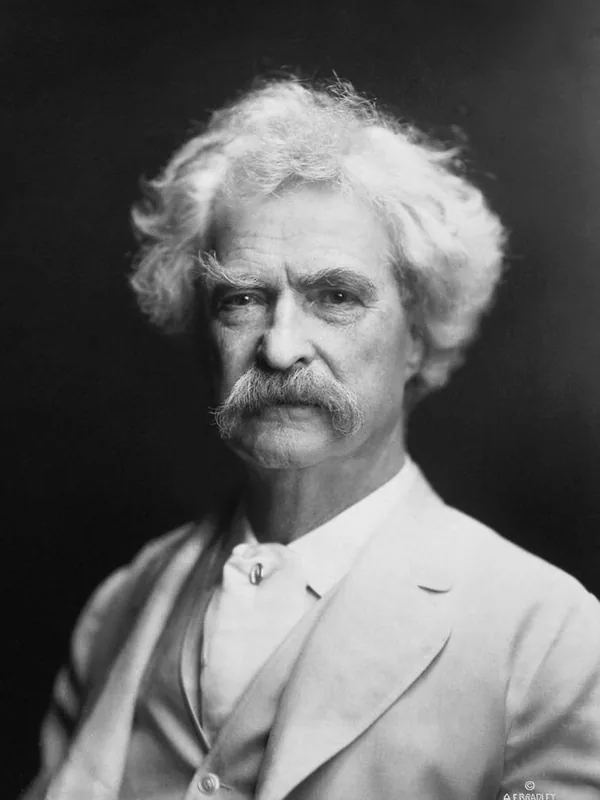
American writer and humorist (1835–1910), born Samuel Langhorne Clemens, whose novels The Adventures of Tom Sawyer and Adventures of Huckleberry Finn made the Mississippi River and American vernacular the matter of great literature.
Early Life
Samuel Langhorne Clemens was born on 30 November 1835 at Florida, Missouri, the sixth child of John Marshall Clemens and Jane Lampton Clemens. When he was four the family moved to Hannibal, a busy Mississippi River port, where he spent the rest of his boyhood — the town that would become St. Petersburg in Tom Sawyer and Huckleberry Finn. His father died in 1847, when Samuel was 11, and the boy left school to work, first as an apprentice to a printer, then as a typesetter in his brother Orion's newspaper office. He left Hannibal in 1853 and worked as a printer in St. Louis, New York, Philadelphia and Cincinnati before returning to the river as a pilot.
Education
Twain had little formal schooling: he left school at 11 after his father's death. He was educated through his work as a printer's apprentice and typesetter, his years as a riverboat pilot, and his own wide reading.
Career
Twain left school at 11 after his father's death and worked as a printer's apprentice and typesetter. He became a licensed Mississippi riverboat pilot in 1859; the Civil War ended river traffic in 1861, and he went west to Nevada, where he worked as a miner and then as a journalist. He first used the pen name 'Mark Twain' — a riverboat sounding term meaning two fathoms of safe water — on 3 February 1863, in a humorous letter from Carson City published in the Virginia City Territorial Enterprise. The Innocents Abroad (1869), an account of a tour of Europe and the Holy Land, made him famous. He married Olivia Langdon in 1870 and settled in Hartford, Connecticut, where the family lived from 1874 to 1891 in the house he built; there he wrote The Adventures of Tom Sawyer (1876), Life on the Mississippi (1883) and Adventures of Huckleberry Finn (1885). He lost his fortune in bad investments and declared bankruptcy in 1894, then repaid his debts through a world lecture tour. He died of a heart attack on 21 April 1910 at his home in Redding, Connecticut, a day after the closest approach of Halley's Comet — the same comet that had appeared in the year of his birth, 1835.
Achievements
Twain's achievement was to make American speech and American places the material of great literature. Adventures of Huckleberry Finn, told in the voice of a boy on the Mississippi, is widely regarded as one of the greatest American novels, and his books brought vernacular American English — dialect, slang and the cadences of ordinary talk — into serious fiction for the first time. He was also one of the first authors to become a public celebrity, famous for his lectures, his white suit and his newspaper persona as much as for his books.
Legacy
Twain is remembered as the defining American writer of the nineteenth century. Huckleberry Finn remains in print in many languages and is taught in schools around the world; the house in Hartford where he wrote his major books is preserved as the Mark Twain House & Museum. His birthday and his death, both under Halley's Comet, have become part of American literary legend, and his aphorisms are still quoted more than a century after his death.
Major Achievements
- Wrote Adventures of Huckleberry Finn (1885), widely regarded as one of the greatest American novels
- Created the Mississippi River as a setting of world literature in The Adventures of Tom Sawyer (1876) and Huckleberry Finn
- Brought American vernacular speech — dialect, slang and the rhythms of ordinary talk — into serious literature
- Built a career that moved between journalism, travel writing, novels and public lecturing, and became a celebrity author
- Published The Innocents Abroad (1869), which made his reputation as a humorist and travel writer
Contributions
Twain made American vernacular English a literary language and the Mississippi River a setting of world literature. His books proved that American subjects, told in American voices, could stand beside the European novel — and his example shaped the American literature that followed, from Hemingway onward.
Notable Works
- The Innocents Abroad (1869)
- Roughing It (1872)
- The Adventures of Tom Sawyer (1876)
- The Prince and the Pauper (1882)
- Life on the Mississippi (1883)
- Adventures of Huckleberry Finn (1885)
- A Connecticut Yankee in King Arthur's Court (1889)
- Pudd'nhead Wilson (1894)
Milestones
- 1835 — Born Samuel Langhorne Clemens on 30 November at Florida, Missouri Source: Encyclopaedia Britannica
- 1839 — Family moved to Hannibal, Missouri — the town that became St. Petersburg in his novels Source: Wikipedia (Mark Twain)
- 1859 — Became a licensed Mississippi riverboat pilot Source: Wikipedia (Mark Twain)
- 1863 — First used the pen name 'Mark Twain', 3 February 1863, in the Virginia City Territorial Enterprise Source: Wikipedia (Mark Twain)
- 1869 — The Innocents Abroad published and made his reputation Source: Encyclopaedia Britannica
- 1870 — Married Olivia Langdon; settled in Hartford, Connecticut Source: Encyclopaedia Britannica
- 1876 — The Adventures of Tom Sawyer published Source: Encyclopaedia Britannica
- 1885 — Adventures of Huckleberry Finn published Source: Encyclopaedia Britannica
- 1910 — Died on 21 April at Redding, Connecticut, of a heart attack Source: Encyclopaedia Britannica
Timeline
- 30 November 1835
Born Samuel Langhorne Clemens at Florida, Missouri, United States
Source: Encyclopaedia Britannica - 1839
Family moved to Hannibal, Missouri, on the Mississippi River
Year only — exact date unknown Source: Wikipedia (Mark Twain) - 1847
Father died; left school at 11 and became a printer's apprentice
Year only — exact date unknown Source: Encyclopaedia Britannica - 1859
Received his riverboat pilot's licence
Year only — exact date unknown Source: Wikipedia (Mark Twain) - 3 February 1863
First used the pen name 'Mark Twain' in the Virginia City Territorial Enterprise
Source: Wikipedia (Mark Twain) - 1869
The Innocents Abroad published; made his reputation
Year only — exact date unknown Source: Encyclopaedia Britannica - 1870
Married Olivia Langdon
Year only — exact date unknown Source: Encyclopaedia Britannica - 1876
The Adventures of Tom Sawyer published
Year only — exact date unknown Source: Encyclopaedia Britannica - 1885
Adventures of Huckleberry Finn published
Year only — exact date unknown Source: Encyclopaedia Britannica - 1894
Declared bankruptcy after losing his fortune in investments
Year only — exact date unknown Source: Encyclopaedia Britannica - 21 April 1910
Died of a heart attack at Redding, Connecticut, a day after Halley's Comet's closest approach
Source: Encyclopaedia Britannica
In Their Words
“I came in with Halley's Comet in 1835. It is coming again next year, and I expect to go out with it.” Source: Mark Twain, 1909 — quoted in Wikipedia (Mark Twain) and Bellevue University Library — Twain's remark in 1909 about Halley's Comet, which appeared in the year of his birth and again in the year of his death.
Related Personalities
Frequently Asked Questions
Who was Mark Twain?
Mark Twain (1835–1910) was an American writer and humorist, born Samuel Langhorne Clemens. He is best known for The Adventures of Tom Sawyer and Adventures of Huckleberry Finn, and for making American vernacular speech a literary language.
Source: Encyclopaedia BritannicaWhere did the pen name 'Mark Twain' come from?
He first used 'Mark Twain' on 3 February 1863, signing a humorous letter from Carson City in the Virginia City Territorial Enterprise. The phrase was a riverboat sounding call meaning 'two fathoms of safe water'.
Source: Wikipedia (Mark Twain)What are Mark Twain's most famous books?
His best-known works are The Innocents Abroad (1869), Roughing It (1872), The Adventures of Tom Sawyer (1876), Life on the Mississippi (1883), Adventures of Huckleberry Finn (1885), The Prince and the Pauper (1882), A Connecticut Yankee in King Arthur's Court (1889) and Pudd'nhead Wilson (1894).
Source: Encyclopaedia BritannicaDid Mark Twain really come in and go out with Halley's Comet?
Twain was born in 1835, the year Halley's Comet appeared, and died on 21 April 1910, a day after the comet's closest approach in 1910. In 1909 he had said, 'I came in with Halley's Comet in 1835. It is coming again next year, and I expect to go out with it.'
Source: Encyclopaedia Britannica; Wikipedia (Mark Twain)What did Mark Twain do before he was a famous writer?
He worked as a printer's apprentice and typesetter, became a licensed Mississippi riverboat pilot in 1859, worked as a miner and journalist in Nevada, and became a famous public lecturer. He declared bankruptcy in 1894 after losing his fortune in investments, and repaid his debts through a world lecture tour.
Source: Encyclopaedia Britannica; Wikipedia (Mark Twain)Sources & References
- Mark Twain — Encyclopaedia Britannica — Encyclopaedia Britannica (accessed 12 November 2026)
- Mark Twain — 1911 Encyclopaedia Britannica (Wikisource) — Wikisource (accessed 12 November 2026)
- Mark Twain — Wikipedia (cross-check) — Wikipedia (accessed 12 November 2026)
- File:Mark Twain by AF Bradley.jpg — Wikimedia Commons (portrait file page) — Wikimedia Commons (accessed 12 November 2026)
