Malala Yousafzai
Education activist · Author
b. 1997 · Born in Mingora, Swat, Pakistan · 3 min read
- Last verified: 12 November 2026
- Sources: 4
- Reviewed by Muse — Phase D second review (independent check)
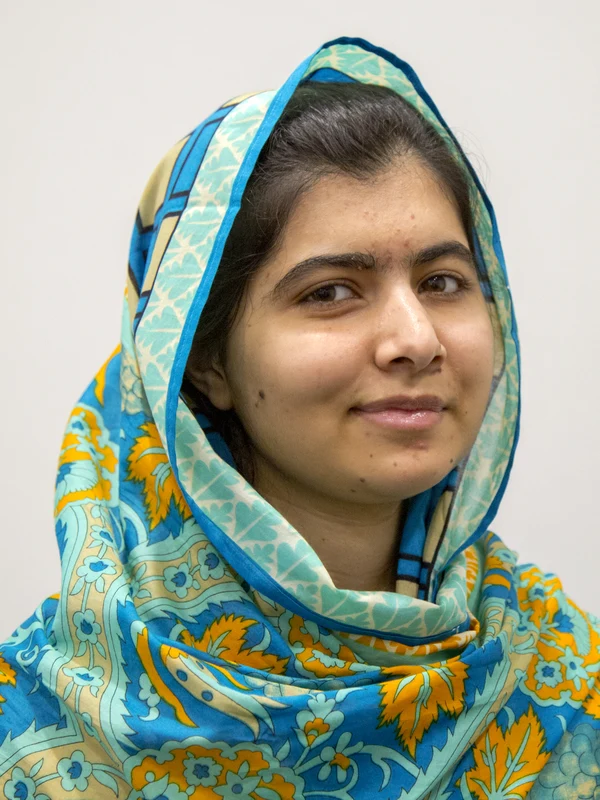
Pakistani education activist who survived a Taliban assassination attempt in 2012 and became the youngest Nobel laureate in history, winning the Peace Prize in 2014 at 17.
Early Life
Malala Yousafzai was born on 12 July 1997 in Mingora, the largest city in the Swat Valley of Pakistan. She was named after Malalai of Maiwand, a 19th-century Afghan folk heroine. Her father, Ziauddin Yousafzai, ran schools in Swat and was himself an education activist. As the Taliban tightened its control over Swat from 2007, girls' schooling came under attack, and from the age of 11 Malala spoke publicly for girls' right to education.
Education
Malala attended the Khushal School in Mingora, one of the schools run by her father. After the attack in 2012 she completed her schooling at Edgbaston High School in Birmingham, England (2013-2017). In 2017 she began studying Philosophy, Politics and Economics at Lady Margaret Hall, Oxford, and graduated in June 2020.
Career
In January 2009, aged 11, Malala began writing a blog for BBC Urdu under the pen name Gul Makai, describing life under Taliban rule and the campaign against girls' schools. A New York Times documentary followed later that year. On 9 October 2012, while travelling home from school on a bus in Swat, she was shot in the head by a Tehrik-i-Taliban Pakistan gunman in an assassination attempt targeting her activism; two other girls were also injured. She was treated first in Pakistan and then at the Queen Elizabeth Hospital in Birmingham, England, where her family settled. On 12 July 2013, her 16th birthday, she addressed the United Nations Youth Assembly in New York. She co-founded the Malala Fund with her father in 2013, published her memoir I Am Malala the same year, and on 10 October 2014 was announced as co-recipient of the Nobel Peace Prize with the Indian children's rights activist Kailash Satyarthi. At 17 she became the youngest Nobel laureate in history. She was named a United Nations Messenger of Peace in April 2017 and graduated from Oxford in 2020. She continues to campaign for girls' education through the Malala Fund.
Achievements
Malala's central achievement is turning a personal attack into a global campaign for girls' education. Her 2013 address to the United Nations, in which she said 'One child, one teacher, one pen and one book can change the world', was watched around the world, and the United Nations declared 12 July Malala Day. The Nobel Peace Prize of 2014, shared with Kailash Satyarthi for their struggle against the suppression of children and young people and for the right of all children to education, made her the youngest laureate in any category. Through the Malala Fund she supports education projects for girls in countries including Pakistan, Nigeria, Syria and Brazil. In 2017 she became the youngest person named a United Nations Messenger of Peace.
Legacy
Malala is the best-known living advocate for girls' education and, as the youngest Nobel laureate, a symbol of young people's capacity to shape public life. Her memoir I Am Malala (2013) has been translated into many languages. Because she is a living person whose work continues, this profile records only documented milestones and will need regular updating from reliable sources.
Major Achievements
- Began writing a BBC Urdu blog under the pen name Gul Makai in January 2009, aged 11, describing life under Taliban rule
- Survived an assassination attempt by a Taliban gunman on 9 October 2012 and recovered after treatment in Birmingham, England
- Addressed the United Nations Youth Assembly on 12 July 2013, her 16th birthday
- Co-founded the Malala Fund in 2013 to campaign for girls' education
- Published the memoir I Am Malala in 2013
- Won the Nobel Peace Prize in 2014, shared with Kailash Satyarthi, becoming the youngest Nobel laureate in history at 17
- Named a United Nations Messenger of Peace in April 2017
- Graduated from the University of Oxford in 2020 with a degree in Philosophy, Politics and Economics
Contributions
Malala's contribution is to have made girls' education a global public cause. She began by documenting, as a schoolgirl, what the loss of schooling meant in Swat, and after surviving an assassination attempt she carried that testimony to the United Nations and to governments. Through the Malala Fund she directs attention and funding to the education of girls in countries where they are most excluded from school, and her Nobel Prize gave that campaign a platform no previous education activist had held.
Notable Works
- I Am Malala (2013, with Christina Lamb)
- Malala's Magic Pencil (2017, children's book)
- We Are Displaced (2019)
Milestones
- 1997 — Born on 12 July in Mingora, Swat Valley, Pakistan Source: NobelPrize.org
- 2009 — Began writing a BBC Urdu blog under the pen name Gul Makai Source: NobelPrize.org
- 2009 — Featured in a New York Times documentary about girls' schooling in Swat Source: NobelPrize.org; Encyclopaedia Britannica
- 2012 — Shot by a Taliban gunman on a school bus on 9 October; survived after treatment in Birmingham Source: NobelPrize.org
- 2013 — Addressed the United Nations Youth Assembly on 12 July, her 16th birthday Source: Malala Fund
- 2013 — Co-founded the Malala Fund with her father Source: NobelPrize.org
- 2013 — Published the memoir I Am Malala Source: NobelPrize.org
- 2014 — Won the Nobel Peace Prize, shared with Kailash Satyarthi, at 17 — the youngest laureate in history Source: NobelPrize.org
- 2017 — Named a United Nations Messenger of Peace in April Source: NobelPrize.org; United Nations
- 2017 — Began studying Philosophy, Politics and Economics at Lady Margaret Hall, Oxford Source: Encyclopaedia Britannica
- 2020 — Graduated from the University of Oxford Source: Encyclopaedia Britannica
- 2021 — Married Asser Malik in Birmingham in November Source: BBC News
Timeline
- 12 July 1997
Born in Mingora, Swat Valley, Pakistan
Source: NobelPrize.org - 2009-01
Began writing a BBC Urdu blog under the pen name Gul Makai
Approximate date Source: NobelPrize.org - 9 October 2012
Shot by a Taliban gunman on a school bus in Swat; two other girls were also injured
Source: NobelPrize.org - 15 October 2012
Transferred to the Queen Elizabeth Hospital in Birmingham, England, for treatment
Source: NobelPrize.org; Encyclopaedia Britannica - 12 July 2013
Addressed the United Nations Youth Assembly in New York on her 16th birthday
Source: Malala Fund - 2013-10
Published the memoir I Am Malala
Approximate date Source: NobelPrize.org - 10 October 2014
Announced as co-recipient of the Nobel Peace Prize with Kailash Satyarthi
Source: NobelPrize.org - 10 December 2014
Received the Nobel Peace Prize in Oslo, the youngest laureate in history at 17
Source: NobelPrize.org - 2017-04
Named a United Nations Messenger of Peace
Approximate date Source: United Nations - 2017-10
Began studying Philosophy, Politics and Economics at Lady Margaret Hall, Oxford
Approximate date Source: Encyclopaedia Britannica - 2020-06
Graduated from the University of Oxford
Approximate date Source: Encyclopaedia Britannica - 2021-11
Married Asser Malik in Birmingham
Approximate date Source: BBC News
In Their Words
“One child, one teacher, one pen and one book can change the world.” Source: Malala Yousafzai, address to the United Nations Youth Assembly, New York, 12 July 2013 (Malala Fund text) — From her first major public address after the attack, delivered on her 16th birthday.
Related Personalities
Frequently Asked Questions
Who is Malala Yousafzai?
Malala Yousafzai (born 12 July 1997) is a Pakistani education activist. She began campaigning for girls' education in Swat at 11, survived a Taliban assassination attempt in 2012, and in 2014, aged 17, became the youngest Nobel laureate in history when she shared the Nobel Peace Prize with Kailash Satyarthi.
Source: NobelPrize.orgWhy was Malala shot?
On 9 October 2012 a Tehrik-i-Taliban Pakistan gunman boarded her school bus in Swat and shot her in the head, in an assassination attempt targeting her for her public campaign for girls' education. Two other girls were also injured. She survived after treatment in Pakistan and then at the Queen Elizabeth Hospital in Birmingham, England.
Source: NobelPrize.orgWhat is the Malala Fund?
The Malala Fund is the organisation Malala co-founded with her father in 2013 to campaign for girls' education and to support education projects for girls in countries including Pakistan, Nigeria, Syria and Brazil. It advocates for 12 years of free, safe, quality education for every girl.
Source: NobelPrize.org; Malala FundWhy is Malala the youngest Nobel laureate?
Malala was 17 when the 2014 Nobel Peace Prize was announced on 10 October 2014, making her the youngest person ever to receive a Nobel Prize in any category. She shared the prize with the Indian children's rights activist Kailash Satyarthi, for their struggle against the suppression of children and young people and for the right of all children to education.
Source: NobelPrize.orgWhat did Malala study at Oxford?
Malala studied Philosophy, Politics and Economics (PPE) at Lady Margaret Hall, Oxford, from 2017 and graduated in June 2020.
Source: Encyclopaedia BritannicaSources & References
- Malala Yousafzai — Biographical — NobelPrize.org — NobelPrize.org (accessed 12 November 2026)
- Malala Yousafzai — Speed read — NobelPrize.org — NobelPrize.org (accessed 12 November 2026)
- Malala Yousafzai: 16th birthday speech at the United Nations — Malala Fund — Malala Fund (accessed 12 November 2026)
- File:Malala Yousafzai 2015.jpg — Wikimedia Commons (portrait file page) — Wikimedia Commons (accessed 12 November 2026)
