Rabindranath Tagore
Poet and writer · Poet · Writer · Composer · Playwright · Painter
1861–1941 · Born in Calcutta (now Kolkata), India · 3 min read
- Last verified: 12 November 2026
- Sources: 4
- Independently reviewed before publication
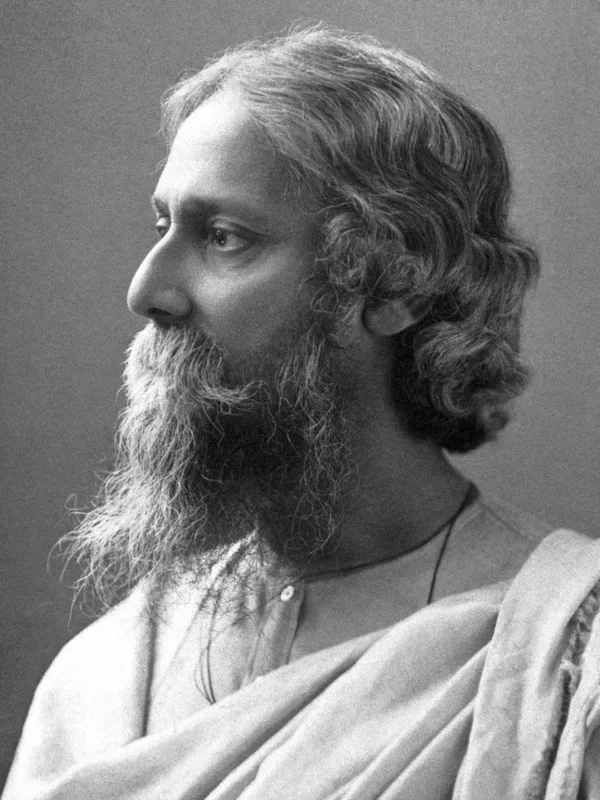
Bengali poet, writer and composer who won the 1913 Nobel Prize in Literature for Gitanjali — the first non-European laureate — and wrote the national anthems of India and Bangladesh.
Early Life
Rabindranath Tagore was born on 7 May 1861 in Calcutta (now Kolkata), India, the youngest son of Debendranath Tagore, a leading figure in the Brahmo Samaj religious reform movement. He was educated largely at home by tutors and published his first poems while still a teenager. In 1878 he travelled to England to study law, but returned to India without taking a degree and devoted himself to writing and to managing the family estates in Bengal, where village life supplied material for his short stories.
Education
Tagore was educated at home in Calcutta and briefly attended school in the city. In 1878 he went to England and enrolled at University College London to study law, but he left without a degree and returned to India the following year.
Career
Tagore began publishing poems as a teenager and published his first poetry collection in his twenties. His Bengali collection Gitanjali (Song Offerings) appeared in 1910; his own English prose translation, with an introduction by W. B. Yeats, was published in London in 1912 and won him the Nobel Prize in 1913. He was knighted by the British crown in 1915 and renounced the knighthood in 1919 as a protest against the Jallianwala Bagh massacre in Amritsar. He travelled widely in Europe, the Americas and Asia, lecturing and building support for Santiniketan, and he painted seriously in his later years, holding exhibitions of his paintings in Europe. He remained active as a writer and educator until his death in 1941.
Achievements
Tagore's central achievement was the Nobel Prize in Literature in 1913, awarded for 'his profoundly sensitive, fresh and beautiful verse' in Gitanjali. He was the first non-European to receive the prize, and the award carried Indian writing to a wide Western readership for the first time. He is the only person in history to have written the national anthems of two countries: Jana Gana Mana, the anthem of India, and Amar Shonar Bangla, the anthem of Bangladesh. As an educator he founded the school at Santiniketan in 1901, built on a blend of Eastern and Western ideas, which became Visva-Bharati University in 1921. His output was enormous: some fifty volumes of verse, novels including Gora (1910) and Ghare-Baire (1916), plays, short stories and about two thousand songs, the body of work known as Rabindra Sangeet.
Legacy
Tagore is generally regarded as the outstanding creative artist of early twentieth-century India. He reshaped Bengali literature, freeing it from classical Sanskrit models by writing in colloquial language and new prose and verse forms, and he helped introduce Indian culture to the West and Western ideas to India. His songs remain a living part of Bengali culture, his school at Santiniketan survives as Visva-Bharati University, and his anthems are sung daily in two countries. He is remembered in India as Gurudev, and his birthday is observed as a cultural occasion in Bengal and Bangladesh.
Major Achievements
- Won the Nobel Prize in Literature in 1913 for Gitanjali, the first non-European to win the prize
- Wrote the national anthems of two countries: Jana Gana Mana (India) and Amar Shonar Bangla (Bangladesh)
- Founded the school at Santiniketan in 1901, which became Visva-Bharati University in 1921
- Published some fifty volumes of verse, plus novels, plays, short stories and about two thousand songs (Rabindra Sangeet)
- Introduced new prose and verse forms and the use of colloquial language into Bengali literature
- Renounced his knighthood in 1919 in protest against the Jallianwala Bagh massacre
Contributions
Tagore's contribution was to make Bengali literature modern and to make Indian writing world literature. He broke with the classical Sanskrit models that dominated Bengali verse, writing in the living language and inventing new prose and verse forms, and he carried the same modernising impulse into the novel, the short story, drama, song and painting. His English Gitanjali proved that an Indian writer could speak to a Western audience in his own voice rather than through a translator, and his school at Santiniketan embodied his belief that education should blend Eastern and Western traditions and take place close to nature rather than in a colonial classroom.
Notable Works
- Gitanjali (Song Offerings) (1910, English 1912)
- Gora (1910)
- Ghare-Baire (The Home and the World) (1916)
- Chitrangada (1892)
- Manasi (1890)
- Sonar Tari (The Golden Boat) (1894)
- Jana Gana Mana (national anthem of India)
- Amar Shonar Bangla (national anthem of Bangladesh)
Milestones
- 1861 — Born on 7 May in Calcutta, India Source: Encyclopaedia Britannica
- 1901 — Founded the school at Santiniketan Source: Encyclopaedia Britannica
- 1910 — Published the Bengali Gitanjali Source: Encyclopaedia Britannica; NobelPrize.org
- 1912 — English Gitanjali published in London with an introduction by W. B. Yeats Source: Encyclopaedia Britannica; NobelPrize.org
- 1913 — Became the first non-European to win the Nobel Prize in Literature Source: NobelPrize.org; Encyclopaedia Britannica
- 1915 — Knighted by the British crown Source: Encyclopaedia Britannica
- 1919 — Renounced his knighthood after the Jallianwala Bagh massacre Source: Encyclopaedia Britannica
- 1921 — Santiniketan became Visva-Bharati University Source: Encyclopaedia Britannica
- 1941 — Died in Calcutta, aged 80 Source: Encyclopaedia Britannica
Timeline
- 7 May 1861
Born in Calcutta, India, youngest son of Debendranath Tagore
Source: Encyclopaedia Britannica - 1878
Travelled to England to study law at University College London; returned without a degree
Year only — exact date unknown Source: Encyclopaedia Britannica - 1901
Founded the school at Santiniketan, near Bolpur in Bengal
Year only — exact date unknown Source: Encyclopaedia Britannica - 1910
Published the Bengali collection Gitanjali (Song Offerings)
Year only — exact date unknown Source: Encyclopaedia Britannica; NobelPrize.org - 1912
His own English translation of Gitanjali published in London with an introduction by W. B. Yeats
Year only — exact date unknown Source: Encyclopaedia Britannica; NobelPrize.org - 1913
Awarded the Nobel Prize in Literature, the first non-European laureate
Year only — exact date unknown Source: NobelPrize.org; Encyclopaedia Britannica - 1915
Knighted by the British crown
Year only — exact date unknown Source: Encyclopaedia Britannica - 1919
Renounced his knighthood in protest against the Jallianwala Bagh massacre
Year only — exact date unknown Source: Encyclopaedia Britannica - 1921
Santiniketan became Visva-Bharati University
Year only — exact date unknown Source: Encyclopaedia Britannica - 7 August 1941
Died in Calcutta, aged 80
Source: Encyclopaedia Britannica
In Their Words
“Where the mind is without fear and the head is held high.” Source: Rabindranath Tagore, Gitanjali (1910) — Opening of the poem 'Where the Mind Is Without Fear', from Gitanjali (1910)
Related Personalities
Frequently Asked Questions
Who was Rabindranath Tagore?
Rabindranath Tagore (1861-1941) was a Bengali poet, short-story writer, composer, playwright and painter, generally regarded as the outstanding creative artist of early twentieth-century India. He won the 1913 Nobel Prize in Literature for Gitanjali.
Source: Encyclopaedia Britannica; NobelPrize.orgWhy did Tagore win the Nobel Prize?
In 1913 Tagore became the first non-European to receive the Nobel Prize in Literature, awarded for 'his profoundly sensitive, fresh and beautiful verse' in Gitanjali. His own English translation of the Bengali poems had been published in London in 1912 with an introduction by W. B. Yeats.
Source: NobelPrize.org; Encyclopaedia BritannicaDid Tagore write two national anthems?
Tagore wrote Jana Gana Mana, the national anthem of India, and Amar Shonar Bangla, the national anthem of Bangladesh. He is the only person to have written the national anthems of two countries.
Source: Encyclopaedia BritannicaWhat is Santiniketan and Visva-Bharati?
In 1901 Tagore founded an experimental school at Santiniketan, near Bolpur in Bengal, where he sought to blend Eastern and Western philosophies and to teach close to nature. It became Visva-Bharati University in 1921.
Source: Encyclopaedia BritannicaWhy did Tagore give up his knighthood?
Tagore was knighted in 1915 but renounced the knighthood in 1919 as a protest against the Jallianwala Bagh massacre in Amritsar, Punjab, where British troops fired on unarmed civilians.
Source: Encyclopaedia BritannicaSources & References
- Rabindranath Tagore — Encyclopaedia Britannica — Encyclopaedia Britannica (accessed 12 November 2026)
- Rabindranath Tagore: Biographical — NobelPrize.org — NobelPrize.org (accessed 12 November 2026)
- The Nobel Prize in Literature 1913, summary — NobelPrize.org — NobelPrize.org (accessed 12 November 2026)
- File:Rabindranath Tagore in 1909.jpg — Wikimedia Commons (portrait file page) — Wikimedia Commons (accessed 12 November 2026)
