Stephen Hawking
Theoretical physicist · Cosmologist · Author
1942–2018 · Born in Oxford, England, United Kingdom · 3 min read
- Last verified: 12 November 2026
- Sources: 4
- Reviewed by Muse — Phase D second review (independent check)
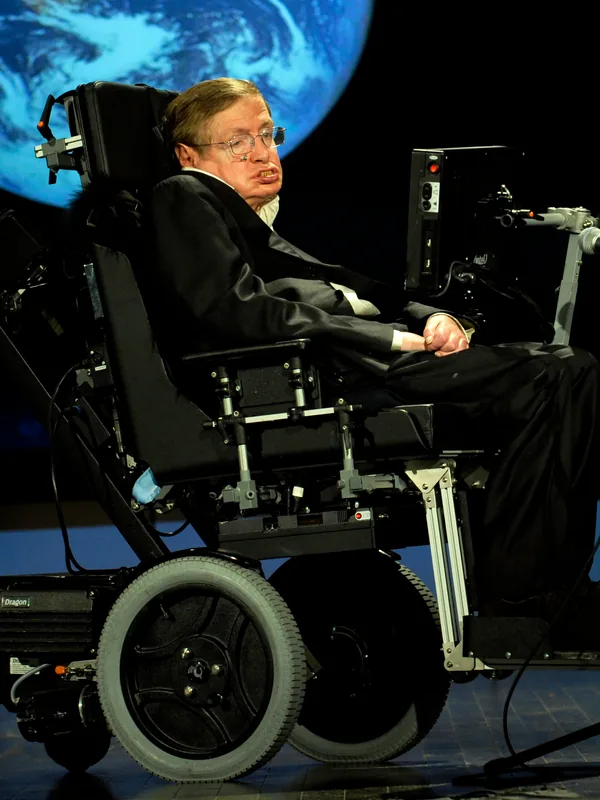
English theoretical physicist who predicted that black holes emit radiation and wrote the best-selling A Brief History of Time; Lucasian Professor at Cambridge.
Early Life
Stephen William Hawking was born on 8 January 1942 in Oxford, England. He studied physics at University College, Oxford, where he earned a bachelor's degree in 1962, and then began doctoral work in cosmology at Trinity Hall, Cambridge. In 1963, at the age of 21, he was diagnosed with motor neurone disease (amyotrophic lateral sclerosis, ALS). Doctors at the time gave him only a few years to live, but he lived with the disease for more than 50 years, continuing his research as his movement and speech became increasingly limited.
Education
Hawking earned a bachelor's degree in physics from University College, Oxford, in 1962, and a doctorate in physics from Trinity Hall, Cambridge, in 1966.
Career
Hawking studied physics at University College, Oxford, graduating in 1962, and moved to Trinity Hall, Cambridge, for a doctorate in cosmology, completed in 1966. He was elected a research fellow at Gonville and Caius College, Cambridge. Working with Roger Penrose, he developed the singularity theorems of the late 1960s and 1970. In 1974 he proposed that black holes emit radiation. He became professor of gravitational physics at Cambridge in 1977, and in 1979 he was appointed Lucasian Professor of Mathematics, a post once held by Isaac Newton, which he held until 2009. He then became Director of Research at the Centre for Theoretical Cosmology, a role he held until his death. Alongside his research he wrote best-selling popular books, including A Brief History of Time (1988), The Universe in a Nutshell (2001) and The Grand Design (2010, with Leonard Mlodinow).
Achievements
Hawking's central scientific achievement was to bring quantum mechanics into the physics of black holes. In 1974 he proposed that black holes are not entirely black: quantum effects near the event horizon mean they emit subatomic particles, now called Hawking radiation, and slowly lose energy. With Roger Penrose he had earlier shown that Einstein's general relativity predicts singularities, points where the known laws of physics break down, at the beginning of the universe and inside black holes. His second achievement was as a communicator: A Brief History of Time (1988) explained the Big Bang, black holes and the nature of time to general readers and became one of the best-selling science books of all time.
Legacy
Hawking is remembered both as one of the leading theoretical physicists of his generation and as the scientist who made cosmology a subject of popular conversation. Hawking radiation remains a prediction rather than a directly observed phenomenon, which is why he was never awarded a Nobel Prize, but it reshaped how physicists think about black holes, information and the connection between gravity and quantum mechanics. His long career with motor neurone disease, and his use of a speech synthesiser to lecture and write, made him a widely recognised public figure. He died in Cambridge on 14 March 2018, and his ashes were interred in Westminster Abbey, near Isaac Newton and Charles Darwin.
Major Achievements
- Proposed in 1974 that black holes emit radiation, now known as Hawking radiation, linking quantum theory with general relativity
- With Roger Penrose, developed singularity theorems showing that general relativity predicts singularities at the start of the universe and inside black holes
- Held the Lucasian Professorship of Mathematics at the University of Cambridge from 1979 to 2009, a chair once held by Isaac Newton
- Wrote A Brief History of Time (1988), one of the best-selling popular science books ever published
- Received the Copley Medal of the Royal Society (2006) and the US Presidential Medal of Freedom (2009)
Contributions
Hawking's work joined general relativity with quantum mechanics in the study of black holes and the early universe. The singularity theorems, developed with Roger Penrose, showed the limits of Einstein's theory, while Hawking radiation suggested that black holes have a temperature and slowly evaporate. His popular writing carried these ideas far beyond physics, making cosmology part of general culture.
Notable Works
- A Brief History of Time (1988)
- The Large Scale Structure of Space-Time (1973, with G. F. R. Ellis)
- The Universe in a Nutshell (2001)
- A Briefer History of Time (2005)
- The Grand Design (2010, with Leonard Mlodinow)
Milestones
- 1942 — Born on 8 January in Oxford, England Source: Encyclopaedia Britannica
- 1962 — Earned a bachelor's degree in physics from University College, Oxford Source: Encyclopaedia Britannica
- 1963 — Diagnosed with motor neurone disease (ALS) at the age of 21 Source: Encyclopaedia Britannica; Acclaimed Figures biography
- 1966 — Earned a doctorate in physics from Trinity Hall, Cambridge Source: Encyclopaedia Britannica
- 1974 — Proposed that black holes emit radiation, now known as Hawking radiation Source: Encyclopaedia Britannica
- 1979 — Appointed Lucasian Professor of Mathematics at Cambridge Source: University of Cambridge; Encyclopaedia Britannica
- 1988 — Published A Brief History of Time Source: Encyclopaedia Britannica
- 2006 — Received the Copley Medal of the Royal Society Source: Encyclopaedia Britannica
- 2009 — Received the US Presidential Medal of Freedom Source: Encyclopaedia Britannica
- 2018 — Died in Cambridge, aged 76 Source: Encyclopaedia Britannica; University of Cambridge
Timeline
- 8 January 1942
Born in Oxford, England
Source: Encyclopaedia Britannica - 1962
Earned a bachelor's degree in physics from University College, Oxford
Year only — exact date unknown Source: Encyclopaedia Britannica - 1963
Diagnosed with motor neurone disease (ALS) at the age of 21
Year only — exact date unknown Source: Encyclopaedia Britannica; Acclaimed Figures biography - 1966
Earned a doctorate in physics from Trinity Hall, Cambridge
Year only — exact date unknown Source: Encyclopaedia Britannica - 1974
Proposed that black holes emit radiation, now known as Hawking radiation
Year only — exact date unknown Source: Encyclopaedia Britannica - 1979
Appointed Lucasian Professor of Mathematics at Cambridge, a post once held by Isaac Newton
Year only — exact date unknown Source: University of Cambridge; Encyclopaedia Britannica - 1988
Published A Brief History of Time, which became a best-selling popular science book
Year only — exact date unknown Source: Encyclopaedia Britannica - 2009
Retired as Lucasian Professor and became Director of Research at the Centre for Theoretical Cosmology
Year only — exact date unknown Source: University of Cambridge - 14 March 2018
Died in Cambridge, aged 76; his ashes were later interred in Westminster Abbey
Source: Encyclopaedia Britannica; University of Cambridge
Related Personalities
Frequently Asked Questions
Who was Stephen Hawking?
Stephen Hawking (1942-2018) was an English theoretical physicist at the University of Cambridge, known for his work on black holes and the origins of the universe, and for the best-selling book A Brief History of Time (1988).
Source: Encyclopaedia BritannicaWhat is Hawking radiation?
Hawking radiation is the prediction Hawking made in 1974 that black holes are not completely black: quantum effects near a black hole's event horizon cause it to emit subatomic particles, so the black hole slowly loses energy and evaporates. The prediction has not been directly observed.
Source: Encyclopaedia Britannica; University of CambridgeDid Stephen Hawking win a Nobel Prize?
No. Hawking was widely tipped for the prize, but he never received one. The Nobel Prize in Physics is awarded for confirmed discoveries, and Hawking radiation, his most famous prediction, has not been directly observed or experimentally confirmed.
Source: Encyclopaedia Britannica; Acclaimed Figures biographyWhat was A Brief History of Time about?
A Brief History of Time: From the Big Bang to Black Holes, published in 1988, explained cosmology, black holes and the nature of time for general readers without equations. It became one of the best-selling popular science books ever published.
Source: Encyclopaedia BritannicaWhat was the Lucasian Professorship that Hawking held?
The Lucasian Professorship of Mathematics at the University of Cambridge, a chair once held by Isaac Newton. Hawking was appointed in 1979 and held it until 2009, when he retired from the post and became Director of Research at the Centre for Theoretical Cosmology.
Source: University of Cambridge; Encyclopaedia BritannicaSources & References
- Stephen Hawking — Encyclopaedia Britannica — Encyclopaedia Britannica (accessed 12 November 2026)
- Stephen Hawking 1942–2018 — University of Cambridge obituary — University of Cambridge (accessed 12 November 2026)
- Stephen Hawking Biography: Theoretical Physicist, Black Hole Radiation — Acclaimed Figures (accessed 12 November 2026)
- File:Stephen hawking 2008 nasa cropped.jpg — Wikimedia Commons (portrait file page) — Wikimedia Commons (accessed 12 November 2026)
