| Profession | Theoretical physicist | Mathematician and physicist |
| Nationality | German-born Swiss-American | English |
| Born | 14 March 1879 in Ulm, Kingdom of Württemberg, German Empire (now Germany) | 4 January 1643 in Woolsthorpe-by-Colsterworth, Lincolnshire, England |
| Died | 18 April 1955 in Princeton, New Jersey, United States | 31 March 1727 in Kensington, London, England |
| Milestones | - 1879 — Born on 14 March in Ulm, Kingdom of Württemberg, German Empire
- 1896 — Enrolled at the Swiss Federal Polytechnic School in Zurich; renounced German citizenship
- 1900 — Graduated from the Swiss Federal Polytechnic with a teaching diploma
- 1901 — Became a Swiss citizen
- 1902 — Began work as a technical examiner at the Swiss Patent Office in Bern
- 1905 — Annus mirabilis: four landmark papers in Annalen der Physik; doctorate from the University of Zurich
- 1909 — Left the patent office for a professorship at the University of Zurich
- 1914 — Moved to Berlin as a member of the Prussian Academy of Sciences
- 1915 — Presented the field equations of general relativity
- 1919 — Solar eclipse expeditions confirmed the bending of starlight predicted by general relativity
- 1922 — Awarded the 1921 Nobel Prize in Physics for the photoelectric effect (presented in 1922)
- 1933 — Left Germany and joined the Institute for Advanced Study in Princeton
- 1939 — Signed the letter to President Roosevelt warning of a possible German atomic bomb programme
- 1940 — Became a citizen of the United States, retaining Swiss citizenship
- 1955 — Died in Princeton, New Jersey, aged 76
| - 1643 — Born at Woolsthorpe Manor, Lincolnshire (4 January 1643 New Style; 25 December 1642 Old Style)
- 1661 — Admitted to Trinity College, Cambridge, as a subsizar
- 1665 — Took his bachelor's degree; the plague years at Woolsthorpe began his work on calculus, optics and gravitation
- 1667 — Elected a fellow of Trinity College, Cambridge
- 1669 — Succeeded Isaac Barrow as Lucasian Professor of Mathematics
- 1672 — Elected a fellow of the Royal Society after demonstrating his reflecting telescope
- 1687 — The Principia was published, setting out the laws of motion and universal gravitation
- 1689 — Served as Member of Parliament for Cambridge University (1689–90)
- 1696 — Moved to London as Warden of the Royal Mint
- 1699 — Became Master of the Royal Mint
- 1703 — Elected president of the Royal Society
- 1704 — Published Opticks
- 1705 — Knighted by Queen Anne, the first scientist to be knighted for scientific work
- 1727 — Died in Kensington, London, aged 84; buried in Westminster Abbey
|
| Achievements | - Published four landmark papers in 1905 — his annus mirabilis — on the photoelectric effect, Brownian motion, special relativity and mass-energy equivalence
- Formulated the special theory of relativity (1905) and the general theory of relativity (1915), describing gravity as the curvature of spacetime
- Awarded the 1921 Nobel Prize in Physics for his explanation of the photoelectric effect (prize presented in 1922)
- Predicted the bending of starlight by gravity, confirmed by the solar eclipse expeditions of 29 May 1919, which made him world-famous
- Co-authored the Einstein-Podolsky-Rosen paper (1935), which framed the debate over quantum entanglement
- Signed the 1939 letter to President Franklin D. Roosevelt warning that Germany might be developing an atomic bomb
- Named Time magazine's Person of the Century in 1999
| - Formulated the three laws of motion and the law of universal gravitation in Philosophiae Naturalis Principia Mathematica (1687), founding classical mechanics
- Co-invented calculus, independently of Gottfried Wilhelm Leibniz, developing the method of fluxions
- Showed with prisms that white light is composed of the colours of the spectrum, founding the science of optics
- Built the first practical reflecting telescope in 1668
- Served as Lucasian Professor of Mathematics at Cambridge from 1669 to 1702
- Served as Warden (1696–1699) and then Master (1699–1727) of the Royal Mint, overseeing the recoinage of England
- President of the Royal Society from 1703 until his death in 1727
- Knighted by Queen Anne in 1705, the first scientist to be knighted for scientific work
|
| Known works | - On the Electrodynamics of Moving Bodies (1905)
- Does the Inertia of a Body Depend Upon Its Energy Content? (1905)
- The Foundation of the General Theory of Relativity (1916)
- Relativity: The Special and the General Theory (1916)
- The Meaning of Relativity (1922)
- The Evolution of Physics (1938, with Leopold Infeld)
| - Philosophiae Naturalis Principia Mathematica (1687)
- Opticks (1704)
- Arithmetica Universalis (1707)
- De analysi per aequationes numero terminorum infinitas (written 1669, published 1711)
|
| Contributions | Einstein's work joined three strands of physics that had seemed separate: light, motion and gravity. Special relativity showed that space and time are not absolute but depend on the observer's motion, and that mass and energy are equivalent. General relativity went further, describing gravity not as a force acting at a distance, as Newton had conceived it, but as the curvature of spacetime caused by mass and energy — a prediction confirmed by the bending of starlight in 1919 and, a century later, by the direct detection of gravitational waves. His 1905 paper on light quanta, for which he won the Nobel Prize, treated light as discrete packets of energy and laid a foundation of quantum theory, even though he remained uneasy about the theory's probabilistic interpretation for the rest of his life. | Newton's contribution was to make physics mathematical. Before the Principia, the motion of the heavens and the motion of objects on Earth were treated as different subjects; Newton's laws of motion and universal gravitation joined them, showing that one inverse-square law governs a falling apple and the orbit of the Moon. In mathematics he developed the method of fluxions — his version of calculus — which gave scientists the tools to describe change and motion. In optics he showed that white light is a mixture of colours and built the reflecting telescope, which replaced the refracting telescope for serious astronomy. As president of the Royal Society and Master of the Mint he also shaped the institutions of British science and public life for a generation. |
| Timeline | - 14 March 1879 — Born in Ulm, Kingdom of Württemberg, German Empire
- 1896 — Enrolled at the Swiss Federal Polytechnic School in Zurich; renounced German citizenship
- 1900 — Graduated from the Swiss Federal Polytechnic with a teaching diploma in mathematics and physics
- 1901 — Became a Swiss citizen
- 1902 — Began work as a technical examiner at the Swiss Patent Office in Bern
- 1903 — Married Mileva Marić, a fellow physics student from Zurich
- 1905 — Annus mirabilis: published four landmark papers in Annalen der Physik and received his doctorate from the University of Zurich
- 1909 — Left the patent office to become associate professor at the University of Zurich
- 1914 — Moved to Berlin as a member of the Prussian Academy of Sciences
- 25 November 1915 — Presented the final form of the field equations of general relativity to the Prussian Academy of Sciences
- 29 May 1919 — Solar eclipse expeditions confirmed the bending of starlight predicted by general relativity
- 1922 — Awarded the 1921 Nobel Prize in Physics for the photoelectric effect (prize presented in 1922)
- 1933-10 — Joined the Institute for Advanced Study in Princeton, New Jersey, after leaving Germany
- 2 August 1939 — Signed the letter to President Franklin D. Roosevelt warning that Germany might be pursuing an atomic bomb
- 1940 — Became a citizen of the United States, retaining Swiss citizenship
- 18 April 1955 — Died in Princeton, New Jersey, aged 76, of an abdominal aortic aneurysm
| - 4 January 1643 — Born at Woolsthorpe Manor, Lincolnshire (25 December 1642 Old Style, on the Julian calendar then used in England)
- 1661-06 — Admitted to Trinity College, Cambridge, as a subsizar
- 1665 — Took his bachelor's degree; plague closed Cambridge and he returned to Woolsthorpe, beginning work on calculus, optics and gravitation
- 1667 — Elected a fellow of Trinity College, Cambridge
- 1669 — Succeeded Isaac Barrow as Lucasian Professor of Mathematics
- 1672 — Elected a fellow of the Royal Society after demonstrating his reflecting telescope; published his paper on light and colours
- 5 July 1687 — The Principia was published, setting out the laws of motion and universal gravitation
- 1696 — Moved to London as Warden of the Royal Mint
- 1699 — Became Master of the Royal Mint
- 1703 — Elected president of the Royal Society, a post he held until his death
- 1704 — Published Opticks, his collected work on light and colour
- 1705-04 — Knighted by Queen Anne at Trinity College, Cambridge
- 31 March 1727 — Died in Kensington, London, aged 84 (20 March 1726 Old Style); buried in Westminster Abbey
|
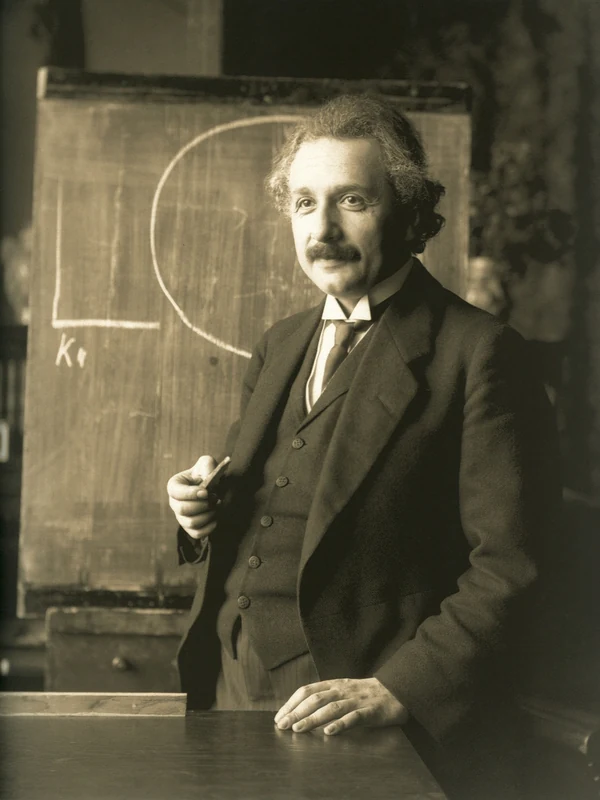 Albert Einstein Theoretical physicist · 1879–1955 Scientists & Inventors
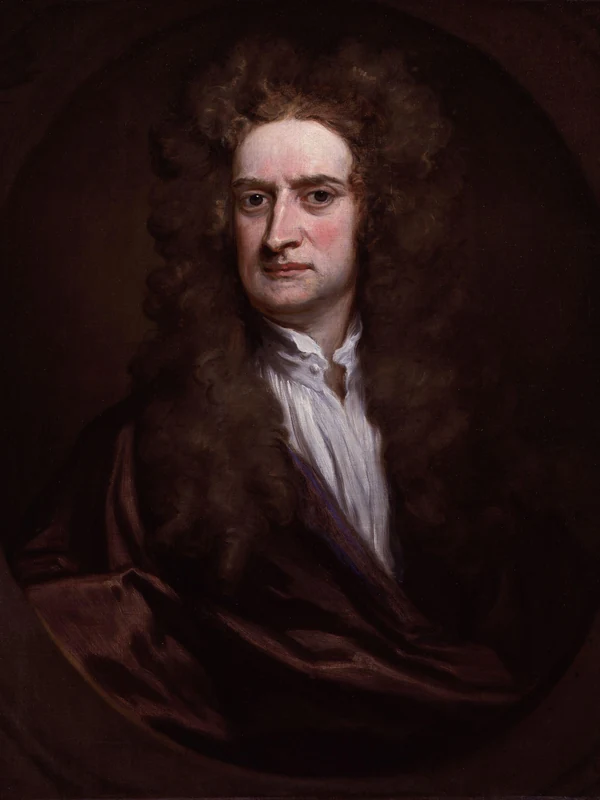 Isaac Newton Mathematician and physicist · 1643–1727 Scientists & Inventors