Abraham Lincoln
President of the United States · Lawyer · Statesman
1809–1865 · Born in Near Hodgenville, Kentucky, United States · 3 min read
- Last verified: 12 November 2026
- Sources: 4
- Independently reviewed before publication
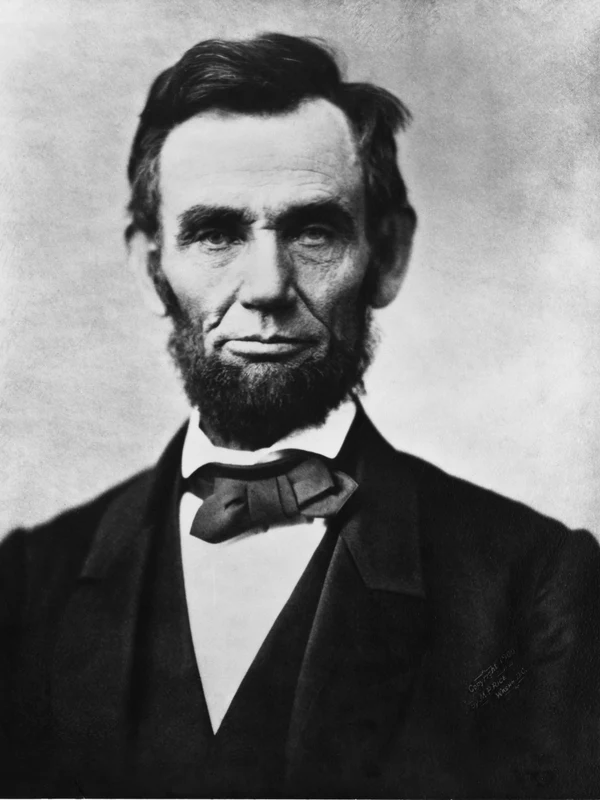
16th president of the United States, who preserved the Union through the Civil War, issued the Emancipation Proclamation, and was assassinated days after the war ended.
Early Life
Abraham Lincoln was born on 12 February 1809 in a one-room log cabin on Sinking Spring Farm near Hodgenville, Kentucky, the son of Thomas Lincoln, a farmer and carpenter, and Nancy Hanks Lincoln. The family moved to Indiana in 1816 and to Illinois in 1830. Lincoln had less than a year of formal schooling in total and was largely self-educated, reading borrowed books by firelight. He worked as a storekeeper, postmaster and surveyor, and served briefly in the Illinois militia during the Black Hawk War of 1832.
Education
Lincoln received almost no formal schooling and was largely self-taught. He studied law on his own while working in New Salem, Illinois, and was admitted to the Illinois bar in 1836.
Career
Lincoln was elected to the Illinois legislature in 1834 and served four terms. He married Mary Todd on 4 November 1842 and built a successful law practice in Springfield. He served one term in the US House of Representatives (1847-1849), then returned to law until the slavery debate drew him back: his 1858 debates with Stephen A. Douglas for the US Senate made him nationally known. Elected president on 6 November 1860, he took office on 4 March 1861 as seven Southern states seceded; the Civil War began at Fort Sumter on 12 April 1861. He issued the preliminary Emancipation Proclamation on 22 September 1862 and the final proclamation on 1 January 1863, delivered the Gettysburg Address on 19 November 1863, was re-elected in November 1864, and promoted the Thirteenth Amendment, passed by Congress on 31 January 1865. General Lee surrendered at Appomattox on 9 April 1865. Five days later, on 14 April, Lincoln was shot by John Wilkes Booth at Ford's Theatre in Washington; he died the next morning, 15 April 1865, aged 56, the first US president to be assassinated.
Achievements
Lincoln's central achievement was preserving the Union through the Civil War while turning the war into a struggle against slavery. The Emancipation Proclamation of 1 January 1863 declared enslaved people in the rebelling states free and authorised Black men to serve in the Union army; the Thirteenth Amendment, which he promoted and which Congress passed in January 1865, abolished slavery throughout the United States. The Gettysburg Address, 272 words delivered in about two minutes, redefined the war as a test of whether a nation dedicated to equality could endure, and remains one of the most quoted speeches in American history. His second inaugural address, delivered on 4 March 1865, called for reconciliation 'with malice toward none'.
Legacy
Lincoln is consistently ranked by historians among the greatest American presidents. He is remembered as the president who saved the Union and ended slavery, and as a writer of extraordinary prose in the Gettysburg Address and the second inaugural. His assassination made him a martyr of the Union cause, and his image — the log cabin, the stovepipe hat, the beard — became an enduring symbol of American democracy. Historians also note that his views on race and on the future of freed people evolved during the war, and debate the pace and limits of his emancipation policy; the profile records that his policy developed over time rather than presenting it as fixed from the start.
Major Achievements
- Elected to the Illinois legislature in 1834 and served four terms
- Won national attention in the 1858 Lincoln-Douglas debates on slavery
- Elected 16th president of the United States on 6 November 1860
- Preserved the Union through the American Civil War (1861-1865)
- Issued the Emancipation Proclamation, effective 1 January 1863
- Delivered the Gettysburg Address on 19 November 1863
- Promoted the Thirteenth Amendment, passed by Congress on 31 January 1865, abolishing slavery in the United States
- Re-elected president in November 1864
Contributions
Lincoln's contribution was to hold a democratic republic together through civil war and to give that war a moral purpose. He combined a lawyer's command of argument with a plain, biblical prose style that made the Union cause intelligible to ordinary people. The Emancipation Proclamation turned a war for the Union into a war against slavery, and the Thirteenth Amendment made abolition permanent. The Gettysburg Address recast the American founding as a promise of equality still to be fulfilled.
Notable Works
- Emancipation Proclamation (1863)
- Gettysburg Address (1863)
- Second Inaugural Address (1865)
- Cooper Union Address (1860)
Milestones
- 1809 — Born on 12 February near Hodgenville, Kentucky Source: Encyclopaedia Britannica
- 1834 — Elected to the Illinois legislature Source: Encyclopaedia Britannica
- 1836 — Admitted to the Illinois bar Source: Encyclopaedia Britannica
- 1842 — Married Mary Todd on 4 November Source: Encyclopaedia Britannica
- 1847 — Elected to the US House of Representatives (1847-1849) Source: Encyclopaedia Britannica
- 1858 — Debated Stephen A. Douglas for the US Senate, gaining national attention Source: Encyclopaedia Britannica
- 1860 — Elected 16th president of the United States on 6 November Source: Encyclopaedia Britannica
- 1861 — Inaugurated 4 March; the Civil War began at Fort Sumter on 12 April Source: Encyclopaedia Britannica
- 1863 — Issued the Emancipation Proclamation on 1 January Source: Encyclopaedia Britannica; US National Archives
- 1863 — Delivered the Gettysburg Address on 19 November Source: Encyclopaedia Britannica; US National Park Service
- 1864 — Re-elected president in November Source: Encyclopaedia Britannica
- 1865 — The Thirteenth Amendment passed Congress on 31 January, abolishing slavery Source: Encyclopaedia Britannica
- 1865 — Shot by John Wilkes Booth on 14 April; died 15 April, the first US president assassinated Source: Encyclopaedia Britannica
Timeline
- 12 February 1809
Born near Hodgenville, Kentucky
Source: Encyclopaedia Britannica - 1834
Elected to the Illinois legislature
Year only — exact date unknown Source: Encyclopaedia Britannica - 1836
Admitted to the Illinois bar
Year only — exact date unknown Source: Encyclopaedia Britannica - 4 November 1842
Married Mary Todd in Springfield, Illinois
Source: Encyclopaedia Britannica - 1847
Elected to the US House of Representatives
Year only — exact date unknown Source: Encyclopaedia Britannica - 1858
Lincoln-Douglas debates for the US Senate
Year only — exact date unknown Source: Encyclopaedia Britannica - 6 November 1860
Elected 16th president of the United States
Source: Encyclopaedia Britannica - 4 March 1861
Inaugurated as president
Source: Encyclopaedia Britannica - 12 April 1861
The Civil War began with the attack on Fort Sumter
Source: Encyclopaedia Britannica - 1 January 1863
Emancipation Proclamation took effect
Source: Encyclopaedia Britannica; US National Archives - 19 November 1863
Delivered the Gettysburg Address
Source: Encyclopaedia Britannica; US National Park Service - 31 January 1865
The Thirteenth Amendment passed Congress
Source: Encyclopaedia Britannica - 15 April 1865
Died in Washington, D.C., after being shot at Ford's Theatre the previous evening
Source: Encyclopaedia Britannica
In Their Words
“that this nation, under God, shall have a new birth of freedom — and that government of the people, by the people, for the people, shall not perish from the earth.” Source: Abraham Lincoln, Gettysburg Address, 19 November 1863 (Bliss copy, as reproduced by the US National Park Service and the Smithsonian) — Closing words of the Gettysburg Address, delivered at the dedication of the Soldiers' National Cemetery, Gettysburg.
Related Personalities
Frequently Asked Questions
Who was Abraham Lincoln?
Abraham Lincoln (1809-1865) was the 16th president of the United States (1861-1865). Born in a log cabin in Kentucky and largely self-educated, he preserved the Union through the Civil War, issued the Emancipation Proclamation, and was assassinated by John Wilkes Booth at Ford's Theatre five days after the war ended.
Source: Encyclopaedia BritannicaWhat was the Emancipation Proclamation?
The Emancipation Proclamation, issued by Lincoln and effective 1 January 1863, declared enslaved people in the states then in rebellion to be free, and authorised Black men to serve in the Union army. It applied only to areas in rebellion, not to the loyal border states, so it did not by itself free all enslaved people; the Thirteenth Amendment, passed by Congress in January 1865, completed abolition.
Source: Encyclopaedia Britannica; US National ArchivesWhat is the Gettysburg Address?
The Gettysburg Address is the speech Lincoln delivered on 19 November 1863 at the dedication of the Soldiers' National Cemetery at Gettysburg, Pennsylvania. In about 272 words it reframed the Civil War as a test of whether a nation dedicated to the proposition that all men are created equal could endure, closing with the words 'government of the people, by the people, for the people, shall not perish from the earth'.
Source: Encyclopaedia Britannica; US National Park ServiceHow did Lincoln die?
On the evening of 14 April 1865, five days after General Lee surrendered at Appomattox, Lincoln was shot in the back of the head by the actor John Wilkes Booth while attending a play at Ford's Theatre in Washington, D.C. He died the following morning, 15 April 1865, aged 56, becoming the first US president to be assassinated.
Source: Encyclopaedia BritannicaWhat is Lincoln's legacy?
Lincoln is remembered as the president who preserved the Union and ended slavery, and as one of the greatest writers among American presidents. Historians consistently rank him among the greatest US presidents, and the Gettysburg Address and his second inaugural remain central texts of American democracy.
Source: Encyclopaedia BritannicaSources & References
- Abraham Lincoln — Encyclopaedia Britannica — Encyclopaedia Britannica (accessed 12 November 2026)
- Abraham Lincoln — Wikipedia (cross-check) — Wikipedia (accessed 12 November 2026)
- Gettysburg Address — US National Park Service — US National Park Service (accessed 12 November 2026)
- File:Abraham Lincoln head on shoulders photo portrait.jpg — Wikimedia Commons (portrait file page) — Wikimedia Commons (accessed 12 November 2026)
