Muhammad Ali Jinnah
Barrister and statesman · Barrister · Statesman · Political leader
1876–1948 · Born in Karachi, Bombay Presidency, British India (now Pakistan) · 4 min read
- Last verified: 12 November 2026
- Sources: 4
- Reviewed by Muse — Phase C second review (independent check)
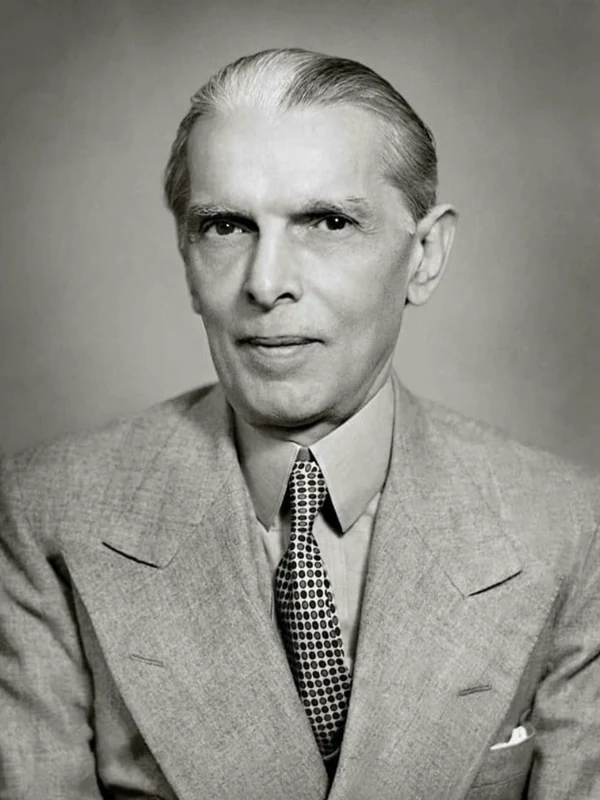
Barrister and statesman who founded Pakistan; led the All-India Muslim League and became Pakistan's first Governor-General in 1947.
Early Life
Muhammad Ali Jinnah was born Mahomedali Jinnahbhai in Karachi, then in the Bombay Presidency of British India, the eldest of seven children of Jinnahbhai Poonja, a Gujarati merchant from Kathiawar, and his wife Mithibai. He was born at Wazir Mansion in Karachi. He was schooled in Karachi and briefly in Bombay. In 1892, at sixteen, he was sent to London to apprentice with the trading firm of Douglas Graham & Co., but he soon abandoned business for law, joining Lincoln's Inn. In 1896, at nineteen, he was called to the Bar, one of the youngest Indians to qualify at the time, and returned to India to practise in Bombay.
Education
Jinnah was educated at schools in Karachi and Bombay before going to London in 1892. He studied law at Lincoln's Inn, one of the four Inns of Court, and was called to the Bar in 1896. He received no university degree; his professional qualification was the Bar, and his training as a barrister — precise argument, constitutional law and procedure — shaped his political style for the rest of his life.
Career
After returning from London in 1896, Jinnah practised law in Bombay, where he became one of the city's most sought-after barristers. He entered politics through the Indian National Congress, which he joined in 1906, and served as private secretary to Dadabhai Naoroji at the Congress session in Calcutta that year. He joined the All-India Muslim League in 1913 while keeping his Congress membership, and used his position in both bodies to broker the Lucknow Pact of 1916. He left Congress in 1920, disagreeing with its turn to mass agitation, and in March 1929 published his Fourteen Points, demanding federalism, provincial autonomy, separate electorates and safeguards for Muslim political rights. After several years in London, where he attended the Round Table Conferences, he returned to India in 1934 and reorganised the Muslim League. The Lahore Resolution of 22–23 March 1940, adopted under his leadership, formally demanded independent states for Muslims in the north-western and eastern zones of British India. In 1946 he called for Direct Action Day to press the demand for Pakistan. Under the 3 June Plan of 1947, Britain agreed to partition; Pakistan came into being on 14 August 1947, and Jinnah became its first Governor-General and president of its Constituent Assembly, serving until his death just over a year later.
Achievements
Jinnah's central achievement was the creation of Pakistan. As a young barrister he first worked for Hindu-Muslim cooperation, brokering the Lucknow Pact of 1916 between the Indian National Congress and the Muslim League. After breaking with Congress in 1920, he set out the Fourteen Points in 1929 as the League's constitutional programme, rebuilt the League from 1934 into a mass organisation, and led it through the Lahore Resolution of March 1940, which demanded separate states for Muslims in British India. In the elections of 1945–46 the League won the great majority of Muslim seats, and when Britain agreed to partition, Jinnah became Pakistan's first head of state. In just over a year as Governor-General he set up the machinery of a new state, supervised the relief of millions of refugees, and presided over the Constituent Assembly that was to write Pakistan's constitution.
Legacy
Jinnah is revered in Pakistan as Quaid-e-Azam (Great Leader) and Baba-e-Qaum (Father of the Nation), and his birth and death anniversaries are national holidays. His 11 August 1947 address to the Constituent Assembly, promising equal rights to all citizens regardless of religion, caste or creed, remains one of the most quoted and debated speeches in Pakistan's history: some read it as a vision of a secular state, others as a statement about citizenship within an Islamic framework, and historians continue to disagree about his intentions. His illness — tuberculosis, which he had suffered from since the 1930s — was kept largely private during his final years, and he died in Karachi on 11 September 1948, aged 71, just over a year after Pakistan's founding. He is buried in Karachi, where the Mazar-e-Quaid mausoleum stands over his grave.
Major Achievements
- Called to the Bar at Lincoln's Inn in 1896, one of the youngest Indians to qualify as a barrister at the time, and built a leading legal practice in Bombay
- Architect of the Lucknow Pact of 1916, the joint Congress–Muslim League agreement on constitutional reform
- Set out the Fourteen Points in March 1929, the constitutional safeguards for Muslims that shaped League policy for a decade
- Reorganised the All-India Muslim League from 1934 and led it to its decisive electoral victories in 1945–46
- Led the adoption of the Lahore Resolution of March 1940, which demanded separate states for Muslims in British India
- Founder and first Governor-General of Pakistan (1947–48), and president of its first Constituent Assembly
- Delivered the 11 August 1947 address to the Constituent Assembly setting out equal citizenship regardless of religion, caste or creed
Contributions
Jinnah's contribution was constitutional and organisational rather than military: he turned the demand for Muslim political safeguards into a state. His early work built a bridge between the Congress and the League through the Lucknow Pact; his later work built the League itself into a party capable of winning elections and negotiating partition. His Fourteen Points framed Muslim demands in constitutional language — federalism, provincial autonomy, separate electorates — that remained the basis of League policy for a decade. As Governor-General he established the precedent that Pakistan's head of state would also preside over its constitution-making assembly, and his 11 August 1947 address set the terms of the continuing debate over religion and citizenship in Pakistan.
Notable Works
- The Lucknow Pact (1916, brokered with the Indian National Congress)
- The Fourteen Points (1929)
- The Lahore Resolution (1940)
- Address to the First Constituent Assembly of Pakistan (11 August 1947)
Milestones
- 1876 — Born Mahomedali Jinnahbhai at Wazir Mansion, Karachi (officially maintained date 25 December 1876; school records give 20 October 1875) Source: Encyclopaedia Britannica
- 1892 — Sent to London; left a business apprenticeship to study law at Lincoln's Inn Source: Encyclopaedia Britannica; Wikipedia
- 1896 — Called to the Bar at Lincoln's Inn, one of the youngest Indians to qualify; began practice in Bombay Source: Encyclopaedia Britannica; Wikipedia
- 1906 — Joined the Indian National Congress Source: Encyclopaedia Britannica
- 1913 — Joined the All-India Muslim League while keeping his Congress membership Source: Encyclopaedia Britannica
- 1916 — Brokered the Lucknow Pact between the Congress and the Muslim League Source: Encyclopaedia Britannica
- 1929 — Published the Fourteen Points, the League's constitutional programme Source: Encyclopaedia Britannica; Wikipedia
- 1934 — Returned to India and began reorganising the Muslim League Source: Encyclopaedia Britannica; Wikipedia
- 1940 — The Muslim League adopted the Lahore Resolution demanding separate states for Muslims in British India Source: Encyclopaedia Britannica
- 1946 — The League won the great majority of Muslim seats in the provincial elections, strengthening the demand for Pakistan Source: Encyclopaedia Britannica; Wikipedia
- 1947 — Elected president of Pakistan's Constituent Assembly; delivered the 11 August address; Pakistan came into being on 14 August and Jinnah became its first Governor-General Source: Encyclopaedia Britannica; Wikipedia
- 1948 — Died in Karachi on 11 September, aged 71 Source: Encyclopaedia Britannica
Timeline
- 25 December 1876
Born Mahomedali Jinnahbhai at Wazir Mansion, Karachi (date disputed — see fact note; school records give 20 October 1875)
Source: Encyclopaedia Britannica - 1892
Sent to London to apprentice with a trading firm; soon left business to study law at Lincoln's Inn
Year only — exact date unknown Source: Encyclopaedia Britannica; Wikipedia - 1896
Called to the Bar at Lincoln's Inn; returned to India and began legal practice in Bombay
Year only — exact date unknown Source: Encyclopaedia Britannica; Wikipedia - 1906
Joined the Indian National Congress; served as private secretary to Dadabhai Naoroji at the Calcutta session
Year only — exact date unknown Source: Encyclopaedia Britannica; Wikipedia - 1913
Joined the All-India Muslim League, while keeping his Congress membership
Year only — exact date unknown Source: Encyclopaedia Britannica - 1916
Brokered the Lucknow Pact between the Congress and the Muslim League
Year only — exact date unknown Source: Encyclopaedia Britannica - 1929-03
Published the Fourteen Points, the League's constitutional programme for safeguarding Muslim political rights
Approximate date Source: Encyclopaedia Britannica; Wikipedia - 1934
Returned to India from London and began reorganising the Muslim League
Year only — exact date unknown Source: Encyclopaedia Britannica; Wikipedia - 23 March 1940
The Muslim League adopted the Lahore Resolution demanding separate states for Muslims in British India
Source: Encyclopaedia Britannica - 11 August 1947
Elected president of Pakistan's Constituent Assembly and delivered his address on equal citizenship
Source: Encyclopaedia Britannica; Wikipedia - 14 August 1947
Pakistan came into being; Jinnah became its first Governor-General
Source: Encyclopaedia Britannica; Wikipedia - 11 September 1948
Died in Karachi, aged 71, after a long illness
Source: Encyclopaedia Britannica
In Their Words
“You are free; you are free to go to your temples, you are free to go to your mosques or to any other place of worship in this State of Pakistan.” Source: Address to the First Constituent Assembly of Pakistan, 11 August 1947 (National Archives of Pakistan) — Address to the First Constituent Assembly of Pakistan, Karachi, 11 August 1947
Related Personalities
Frequently Asked Questions
Who was Muhammad Ali Jinnah?
Muhammad Ali Jinnah (1876–1948) was a barrister and statesman who founded Pakistan. He led the All-India Muslim League from 1913 until Pakistan's independence on 14 August 1947, and then served as Pakistan's first Governor-General until his death a year later. In Pakistan he is revered as Quaid-e-Azam (Great Leader) and Baba-e-Qaum (Father of the Nation).
Source: Encyclopaedia Britannica; WikipediaWhen was Muhammad Ali Jinnah born?
Jinnah maintained that he was born on 25 December 1876 in Karachi, and that is the date officially observed in Pakistan. His earliest school records in Karachi, however, give 20 October 1875. Both dates appear in reliable sources, so the birth date is genuinely disputed; this profile uses the officially maintained date and records the alternative in a fact note.
Source: Encyclopaedia BritannicaWhere did Jinnah study law?
He studied law at Lincoln's Inn in London and was called to the Bar in 1896, at nineteen, one of the youngest Indians to qualify at the time. He then built a leading legal practice in Bombay before entering politics.
Source: Encyclopaedia Britannica; WikipediaWhat was the Lahore Resolution of 1940?
The Lahore Resolution, adopted by the Muslim League in Lahore on 22–23 March 1940, formally demanded independent states for Muslims in the north-western and eastern zones of British India. It turned the League's demand from constitutional safeguards within a united India into a demand for a separate state, and it is the foundation of the Pakistan movement.
Source: Encyclopaedia BritannicaHow did Muhammad Ali Jinnah die?
He died on 11 September 1948 in Karachi, aged 71, just over a year after Pakistan's independence. He had suffered from tuberculosis since the 1930s, an illness that was kept largely private during his final years.
Source: Encyclopaedia Britannica; Wikipedia (cross-checked)Sources & References
- Mohammed Ali Jinnah — Encyclopaedia Britannica — Encyclopaedia Britannica (accessed 12 November 2026)
- Muhammad Ali Jinnah — Wikipedia (cross-check) — Wikipedia (accessed 12 November 2026)
- Jinnah, Muhammad Ali — FactMonster — FactMonster / Columbia Encyclopedia (accessed 12 November 2026)
- File:Muhammad Ali Jinnah.png — Wikimedia Commons (portrait file page) — Wikimedia Commons (accessed 12 November 2026)
