Winston Churchill
Prime Minister of the United Kingdom · Prime Minister · Statesman · Author · Military officer
1874–1965 · Born in Blenheim Palace, Oxfordshire, England · 3 min read
- Last verified: 12 November 2026
- Sources: 5
- Independently reviewed before publication
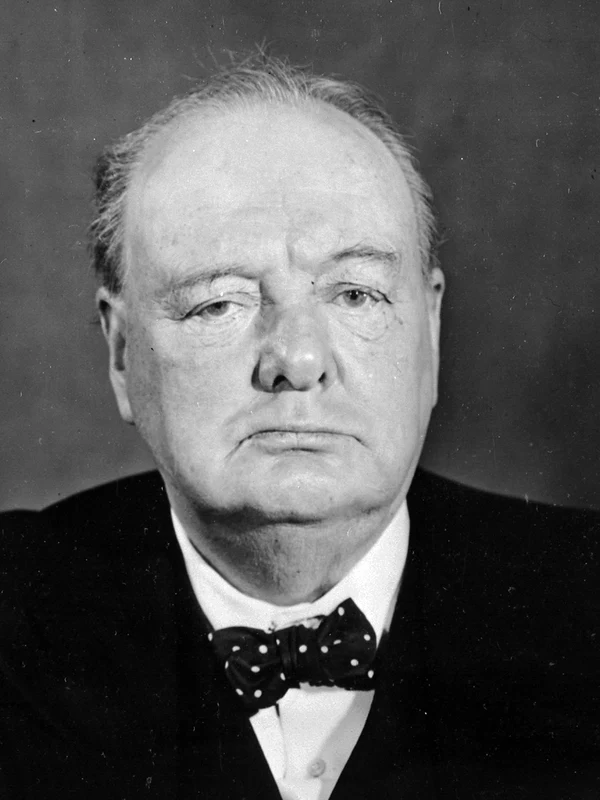
British prime minister who led the United Kingdom through the Second World War, and a prolific author who won the 1953 Nobel Prize in Literature.
Early Life
Winston Leonard Spencer Churchill was born on 30 November 1874 at Blenheim Palace in Oxfordshire, the eldest son of Lord Randolph Churchill, a Conservative politician, and Jennie Jerome, the daughter of an American financier. He was educated at Harrow School and the Royal Military College, Sandhurst, and was commissioned into the 4th Queen's Own Hussars in 1895.
Education
Churchill was educated at Harrow School and the Royal Military College, Sandhurst (1893-1894), where he graduated before being commissioned as a cavalry officer in 1895.
Career
Churchill served as a soldier and war correspondent in Cuba, India and Sudan, and in the Boer War in South Africa, where he was captured in 1899 and escaped from a prisoner-of-war camp. He was elected to Parliament in 1900, served as Home Secretary in 1910 and as First Lord of the Admiralty from 1911 to 1915, resigning after the failed Dardanelles campaign at Gallipoli. He returned to government as Minister of Munitions in 1917 and served as Chancellor of the Exchequer from 1924 to 1929. Out of office in the 1930s — the 'wilderness years' — he warned against German rearmament and appeasement. He returned as First Lord of the Admiralty in September 1939 and became prime minister on 10 May 1940, leading Britain through the Second World War until July 1945. In 1946 he warned of an 'Iron Curtain' descending across Europe. He returned as prime minister from 1951 to 1955, won the Nobel Prize in Literature in 1953, resigned in April 1955, and died in London on 24 January 1965, aged 90, receiving a state funeral.
Achievements
Churchill's central achievement was leading Britain through the Second World War after the fall of France in 1940, refusing to consider a negotiated peace when Britain stood alone. His speeches of 1940 — 'We shall fight on the beaches' on 4 June and 'their finest hour' on 18 June — rallied the country during the Battle of Britain and the Blitz. With Franklin D. Roosevelt and Joseph Stalin he shaped Allied strategy, and after the war he was among the first to warn the West about Soviet expansion, in his 'Iron Curtain' speech at Fulton, Missouri, on 5 March 1946. As a writer he produced more than 40 books, including the six-volume The Second World War, and won the 1953 Nobel Prize in Literature for his mastery of historical and biographical description and his brilliant oratory.
Legacy
Churchill is remembered in Britain as the wartime leader who refused to surrender in 1940 and as one of the great orators of the twentieth century. His legacy is also contested: his record on empire and India, including his government's role during the 1943 Bengal famine, is debated by historians, with some arguing that wartime policy decisions worsened the famine and others that crop failure, wartime conditions and local administration were decisive. His views on race and empire, common among British politicians of his generation, are likewise assessed critically by modern historians. The profile presents these debates with both sides attributed rather than settling them.
Major Achievements
- Elected to Parliament in 1900 after service as a soldier and war correspondent
- Served as First Lord of the Admiralty, 1911-1915, and again from September 1939
- Served as Chancellor of the Exchequer, 1924-1929
- Became prime minister on 10 May 1940 and led Britain through the Second World War
- Delivered the 'We shall fight on the beaches' speech on 4 June 1940 and the 'finest hour' speech on 18 June 1940
- Delivered the 'Iron Curtain' speech at Fulton, Missouri, on 5 March 1946
- Returned as prime minister, 1951-1955
- Won the Nobel Prize in Literature in 1953 for his historical writings and oratory
- Received a state funeral on 30 January 1965
Contributions
Churchill's contribution was leadership through language as much as through policy: his 1940 speeches gave a country facing invasion a reason to keep fighting, and his histories shaped how the war was remembered. As a politician he moved between parties and offices for six decades, from cavalry officer to prime minister twice. As a writer he produced histories, memoirs and biography at a scale few statesmen have matched, and the Nobel Prize in Literature recognised the writer as much as the statesman.
Notable Works
- The World Crisis (1923-1931)
- My Early Life (1930)
- Marlborough: His Life and Times (1933-1938)
- The Second World War (1948-1953)
- A History of the English-Speaking Peoples (1956-1958)
Milestones
- 1874 — Born on 30 November at Blenheim Palace, Oxfordshire Source: Encyclopaedia Britannica
- 1895 — Commissioned into the 4th Queen's Own Hussars after Sandhurst Source: Encyclopaedia Britannica
- 1899 — Captured in the Boer War and escaped from a prisoner-of-war camp Source: Encyclopaedia Britannica
- 1900 — Elected to Parliament as MP for Oldham Source: Encyclopaedia Britannica
- 1911 — Appointed First Lord of the Admiralty Source: Encyclopaedia Britannica
- 1915 — Resigned after the failed Dardanelles campaign at Gallipoli Source: Encyclopaedia Britannica
- 1924 — Appointed Chancellor of the Exchequer (1924-1929) Source: Encyclopaedia Britannica
- 1940 — Became prime minister on 10 May 1940 Source: Encyclopaedia Britannica
- 1940 — Delivered the 'We shall fight on the beaches' speech on 4 June 1940 Source: UK Parliament (Hansard)
- 1946 — Delivered the 'Iron Curtain' speech at Fulton, Missouri, on 5 March Source: Encyclopaedia Britannica
- 1951 — Returned as prime minister (1951-1955) Source: Encyclopaedia Britannica
- 1953 — Won the Nobel Prize in Literature Source: NobelPrize.org; Encyclopaedia Britannica
- 1965 — Died in London on 24 January, aged 90; given a state funeral Source: Encyclopaedia Britannica
Timeline
- 30 November 1874
Born at Blenheim Palace, Oxfordshire
Source: Encyclopaedia Britannica - 1895
Commissioned into the 4th Queen's Own Hussars
Year only — exact date unknown Source: Encyclopaedia Britannica - 1899-12
Escaped from a Boer prisoner-of-war camp
Approximate date Source: Encyclopaedia Britannica - 1900
Elected to Parliament as MP for Oldham
Year only — exact date unknown Source: Encyclopaedia Britannica - 1911
Appointed First Lord of the Admiralty
Year only — exact date unknown Source: Encyclopaedia Britannica - 1915
Resigned after the failed Dardanelles campaign at Gallipoli
Year only — exact date unknown Source: Encyclopaedia Britannica - 1924
Appointed Chancellor of the Exchequer
Year only — exact date unknown Source: Encyclopaedia Britannica - 10 May 1940
Became prime minister, succeeding Neville Chamberlain
Source: Encyclopaedia Britannica - 4 June 1940
Delivered the 'We shall fight on the beaches' speech in the House of Commons
Source: UK Parliament (Hansard) - 5 March 1946
Delivered the 'Iron Curtain' speech at Fulton, Missouri
Source: Encyclopaedia Britannica - 26 October 1951
Returned as prime minister
Source: Encyclopaedia Britannica - 1953
Awarded the Nobel Prize in Literature
Year only — exact date unknown Source: NobelPrize.org; Encyclopaedia Britannica - 24 January 1965
Died at Hyde Park Gate, London, aged 90
Source: Encyclopaedia Britannica
In Their Words
“We shall fight on the beaches, we shall fight on the landing grounds, we shall fight in the fields and in the streets, we shall fight in the hills; we shall never surrender.” Source: Winston Churchill, 'War Situation' speech, House of Commons, 4 June 1940 (Hansard, 5th Series, vol. 361) — Speech to the House of Commons after the Dunkirk evacuation, 4 June 1940.
Related Personalities
Frequently Asked Questions
Who was Winston Churchill?
Winston Churchill (1874-1965) was a British statesman, soldier and writer who was prime minister of the United Kingdom from 1940 to 1945, during the Second World War, and again from 1951 to 1955. He won the Nobel Prize in Literature in 1953 for his historical writings and oratory.
Source: Encyclopaedia BritannicaWhat did Churchill do during the Second World War?
Churchill became prime minister on 10 May 1940, the day Germany invaded France and the Low Countries. He refused to consider a negotiated peace, rallied Britain with speeches such as 'We shall fight on the beaches' (4 June 1940), oversaw the Dunkirk evacuation and the Battle of Britain, and with Roosevelt and Stalin shaped Allied strategy until the end of the war in Europe.
Source: Encyclopaedia Britannica; UK Parliament (Hansard)Why did Churchill win the Nobel Prize?
Churchill won the 1953 Nobel Prize in Literature, not the Peace Prize, for his mastery of historical and biographical description and for brilliant oratory in defending exalted human values. The award recognised his writing, above all the six-volume The Second World War, as well as his speeches. He had been nominated for the literature prize 21 times between 1946 and 1953.
Source: NobelPrize.org; Encyclopaedia BritannicaWhat was the Iron Curtain speech?
On 5 March 1946 Churchill spoke at Westminster College in Fulton, Missouri, and said that 'an iron curtain has descended across the Continent'. The phrase became the standard description of the division of Europe between the Soviet-dominated east and the democratic west, and the speech is regarded as an early statement of Cold War policy.
Source: Encyclopaedia BritannicaWhy is Churchill's legacy debated?
Churchill is celebrated for his wartime leadership and oratory, but his record is contested. Historians debate his government's role in the 1943 Bengal famine — some argue wartime policy decisions worsened it, others that crop failure, wartime conditions and local administration were decisive — and his views on empire and race are assessed critically by modern historians. The profile presents both sides of these debates.
Source: Encyclopaedia BritannicaSources & References
- Winston Churchill — Encyclopaedia Britannica — Encyclopaedia Britannica (accessed 12 November 2026)
- Winston Churchill — Wikipedia (cross-check) — Wikipedia (accessed 12 November 2026)
- Facts on the Nobel Prize in Literature — NobelPrize.org — NobelPrize.org (accessed 12 November 2026)
- War Situation, Hansard, 4 June 1940 — UK Parliament — UK Parliament (accessed 12 November 2026)
- File:Winston Churchill C3519635.jpg — Wikimedia Commons (portrait file page) — Wikimedia Commons (accessed 12 November 2026)
