Benazir Bhutto
Politician · Prime minister
1953–2007 · Born in Karachi, Pakistan · 4 min read
- Last verified: 12 November 2026
- Sources: 4
- Reviewed by Muse — Phase D second review (independent check)
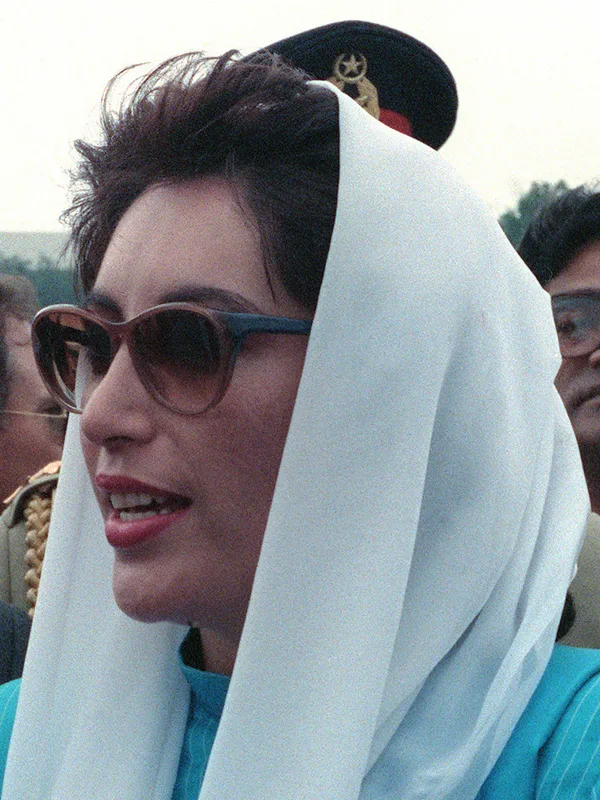
Pakistani politician who became the first woman to lead a Muslim-majority country, serving as prime minister in 1988–90 and 1993–96; assassinated while campaigning in 2007.
Early Life
Benazir Bhutto was born on 21 June 1953 in Karachi, Pakistan, the eldest child of Zulfikar Ali Bhutto, later president and prime minister of Pakistan, and Nusrat Bhutto. She was educated at convent schools in Pakistan, then at Radcliffe College, Harvard University, from 1969 to 1973, where she studied comparative government and graduated with a bachelor's degree. In the autumn of 1973 she moved to Britain to study Philosophy, Politics and Economics at Lady Margaret Hall, University of Oxford, taking a second bachelor's degree and further courses in international law and diplomacy at St Catherine's College. In 1977 she became the first Asian woman to be elected president of the Oxford Union debating society.
Education
Bhutto studied comparative government at Radcliffe College, Harvard University, from 1969 to 1973, graduating with a bachelor's degree. She then studied Philosophy, Politics and Economics at Lady Margaret Hall, University of Oxford, from 1973 to 1977, and took further courses in international law and diplomacy at St Catherine's College, Oxford.
Career
Bhutto returned to Pakistan in June 1977, weeks before her father, Prime Minister Zulfikar Ali Bhutto, was overthrown in a military coup led by General Muhammad Zia-ul-Haq. After her father's execution in 1979, she and her mother Nusrat Bhutto took charge of the Pakistan People's Party — Benazir became its chairperson in November 1982 — and she spent nearly six years in prison or under house arrest. She lived in exile in London from 1984 and returned to a mass welcome in 1986. After Zia's death in a plane crash in August 1988, she led the PPP to victory in the November elections and was sworn in as prime minister on 2 December 1988, heading a coalition government. President Ghulam Ishaq Khan dismissed her government in August 1990. She returned as prime minister after the October 1993 elections and served until President Farooq Leghari dismissed her government in November 1996. She left Pakistan in 1999 and lived in self-imposed exile in Dubai and London. In May 2006 she and her old rival Nawaz Sharif signed the Charter of Democracy in London. Under an amnesty from President Pervez Musharraf she returned to Karachi on 18 October 2007; a bombing of her convoy that day killed some 139 people, though she survived. On 27 December 2007, after addressing a rally at Liaquat Bagh in Rawalpindi, she was assassinated by a gunman and a suicide bomber.
Achievements
Bhutto's central achievement was to become the first woman to lead a Muslim-majority country, serving as prime minister of Pakistan in 1988-1990 and again in 1993-1996. She took office at 35, leading the Pakistan People's Party to victory in the 1988 elections after eleven years of military rule under General Zia-ul-Haq, and headed Pakistan's first civilian government since her father's government was overthrown in 1977. She was the first Asian woman elected president of the Oxford Union, in 1977, and she chaired the PPP from the early 1980s until her death. After eight years in self-imposed exile she returned to Pakistan in October 2007 to contest the 2008 elections, and in 2008 she was posthumously awarded the United Nations Human Rights Prize.
Legacy
Bhutto remains a defining figure in Pakistan's democratic history and a symbol for women in politics across the Muslim world. Her supporters credit her with restoring civilian rule, reopening political space after military government, and giving Pakistan its first elected woman head of government; her critics point to the corruption allegations that ended both her governments and to the failure of her administrations to deliver on their promises. She is buried in the family mausoleum at Garhi Khuda Bakhsh in Sindh, beside her father, and the PPP she led went on to win the February 2008 elections in the aftermath of her assassination, with her husband Asif Ali Zardari later becoming president and her son Bilawal Bhutto Zardari later becoming foreign minister.
Major Achievements
- Became the first woman to lead a Muslim-majority country, serving as prime minister of Pakistan in 1988-1990 and 1993-1996
- Led the Pakistan People's Party (PPP) from the early 1980s until her assassination in 2007
- Became the first Asian woman elected president of the Oxford Union, in 1977
- Chaired the PPP's return to power in the 1988 elections after eleven years of military rule
- Signed the Charter of Democracy with Nawaz Sharif in London in May 2006
- Received the United Nations Human Rights Prize posthumously in 2008
Contributions
Bhutto's contribution was to carry a democratic party through dictatorship and back into government. As head of the PPP after her father's execution, she kept the party alive through imprisonment, house arrest and exile, and in 1988 she turned it into the vehicle of Pakistan's return to civilian rule. In office she reopened political freedoms, restored trade unions and student organisations banned under military rule, and promoted women's welfare measures. Her career also showed the limits of that restoration: both her governments were cut short by presidential dismissal, and the corruption cases brought against her and her husband dominated her later years, shaping the debate about accountability and political victimisation in Pakistan that continues today.
Notable Works
- Daughter of the East (autobiography, 1988; also published as Daughter of Destiny, 1989)
- Reconciliation: Islam, Democracy, and the West (published posthumously, 2008)
- Pakistan People's Party (chair, 1980s-2007)
Milestones
- 1953 — Born on 21 June in Karachi, Pakistan Source: Encyclopaedia Britannica
- 1977 — Became the first Asian woman elected president of the Oxford Union Source: Encyclopaedia Britannica
- 1979 — Her father was overthrown in a military coup and later executed; she and her mother Nusrat Bhutto took charge of the Pakistan People's Party (Benazir became its chairperson in November 1982) Source: Encyclopaedia Britannica
- 1986 — Returned to Pakistan from exile Source: Encyclopaedia Britannica
- 1988 — Sworn in as prime minister, the first woman to lead a Muslim-majority country Source: EBSCO Research Starters; Encyclopaedia Britannica
- 1990 — Dismissed by President Ghulam Ishaq Khan Source: Encyclopaedia Britannica
- 1993 — Returned as prime minister after the October elections Source: Encyclopaedia Britannica
- 1996 — Dismissed by President Farooq Leghari Source: Encyclopaedia Britannica
- 2006 — Signed the Charter of Democracy with Nawaz Sharif Source: Encyclopaedia Britannica
- 2007 — Returned to Pakistan after eight years in exile; survived a bombing of her convoy in Karachi Source: EBSCO Research Starters
- 2007 — Assassinated in Rawalpindi while campaigning for the 2008 elections Source: Encyclopaedia Britannica; EBSCO Research Starters
Timeline
- 21 June 1953
Born in Karachi, Pakistan, eldest child of Zulfikar Ali Bhutto and Nusrat Bhutto
Source: Encyclopaedia Britannica - 1969
Began studying comparative government at Radcliffe College, Harvard University
Year only — exact date unknown Source: Encyclopaedia Britannica; EBSCO Research Starters - 1973
Graduated from Harvard; moved to Britain to study at Lady Margaret Hall, Oxford
Year only — exact date unknown Source: Encyclopaedia Britannica - 1977
Became the first Asian woman elected president of the Oxford Union; returned to Pakistan in June
Year only — exact date unknown Source: Encyclopaedia Britannica; EBSCO Research Starters - 5 July 1977
Her father was overthrown in a military coup led by General Muhammad Zia-ul-Haq
Source: Encyclopaedia Britannica - 1979
Her father Zulfikar Ali Bhutto was executed; she and her mother Nusrat Bhutto took charge of the Pakistan People's Party (Benazir became its chairperson in November 1982)
Year only — exact date unknown Source: Encyclopaedia Britannica - 1986
Returned to Pakistan from exile in London to a mass welcome
Year only — exact date unknown Source: Encyclopaedia Britannica - 2 December 1988
Sworn in as prime minister of Pakistan, the first woman to lead a Muslim-majority country
Source: EBSCO Research Starters; Encyclopaedia Britannica - 1990-08
Dismissed by President Ghulam Ishaq Khan
Approximate date Source: Encyclopaedia Britannica - 1993-10
Returned as prime minister after the PPP won the October elections
Approximate date Source: Encyclopaedia Britannica - 1996-11
Dismissed by President Farooq Leghari
Approximate date Source: Encyclopaedia Britannica - 1999
Left Pakistan for self-imposed exile
Year only — exact date unknown Source: Encyclopaedia Britannica - 2006-05
Signed the Charter of Democracy with Nawaz Sharif in London
Approximate date Source: Encyclopaedia Britannica - 18 October 2007
Returned to Karachi; a bombing of her convoy killed some 139 people, though she survived
Source: EBSCO Research Starters - 27 December 2007
Assassinated in Rawalpindi after addressing a rally at Liaquat Bagh while campaigning for the 2008 elections
Source: Encyclopaedia Britannica; EBSCO Research Starters
Related Personalities
Frequently Asked Questions
Who was Benazir Bhutto?
Benazir Bhutto (1953-2007) was a Pakistani politician who became the first woman to lead a Muslim-majority country. She served as prime minister of Pakistan in 1988-1990 and 1993-1996 and chaired the Pakistan People's Party from the early 1980s until her assassination.
Source: Encyclopaedia BritannicaWhen was Benazir Bhutto prime minister, and why did her governments end?
Bhutto was prime minister twice: from December 1988 to August 1990, when President Ghulam Ishaq Khan dismissed her government, and from October 1993 to November 1996, when President Farooq Leghari dismissed it. Both dismissals were made amid allegations of corruption, which she denied.
Source: Encyclopaedia Britannica; EBSCO Research StartersWhere was Benazir Bhutto educated?
Bhutto studied comparative government at Radcliffe College, Harvard, graduating in 1973, then read Philosophy, Politics and Economics at Lady Margaret Hall, Oxford. In 1977 she became the first Asian woman elected president of the Oxford Union.
Source: Encyclopaedia Britannica; EBSCO Research StartersHow was Benazir Bhutto assassinated?
Bhutto returned to Pakistan on 18 October 2007 after eight years in exile. On 27 December 2007, after addressing a rally at Liaquat Bagh in Rawalpindi while campaigning for the 2008 elections, she was assassinated by a gunman and a suicide bomber. The exact mechanism of her death remains disputed.
Source: Encyclopaedia Britannica; EBSCO Research StartersWho was Benazir Bhutto's father?
Bhutto was the daughter of Zulfikar Ali Bhutto, who led Pakistan from 1971 until he was overthrown in 1977 and executed in 1979. She took charge of his party, the Pakistan People's Party, with her mother Nusrat Bhutto after his execution, becoming its chairperson in November 1982.
Source: Encyclopaedia BritannicaSources & References
- Benazir Bhutto — Encyclopaedia Britannica — Encyclopaedia Britannica (accessed 12 November 2026)
- Benazir Bhutto — EBSCO Research Starters biography — EBSCO (accessed 12 November 2026)
- Benazir Bhutto's mixed legacy — OUPblog — Oxford University Press (accessed 12 November 2026)
- File:Benazir bhutto 1989.jpg — Wikimedia Commons (portrait file page) — Wikimedia Commons (accessed 12 November 2026)
