Mahatma Gandhi
Political leader · Lawyer · Anti-colonial activist · Writer
1869–1948 · Born in Porbandar, Gujarat, British India · 3 min read
- Last verified: 12 November 2026
- Sources: 4
- Reviewed by Muse — Phase D second review (independent check)
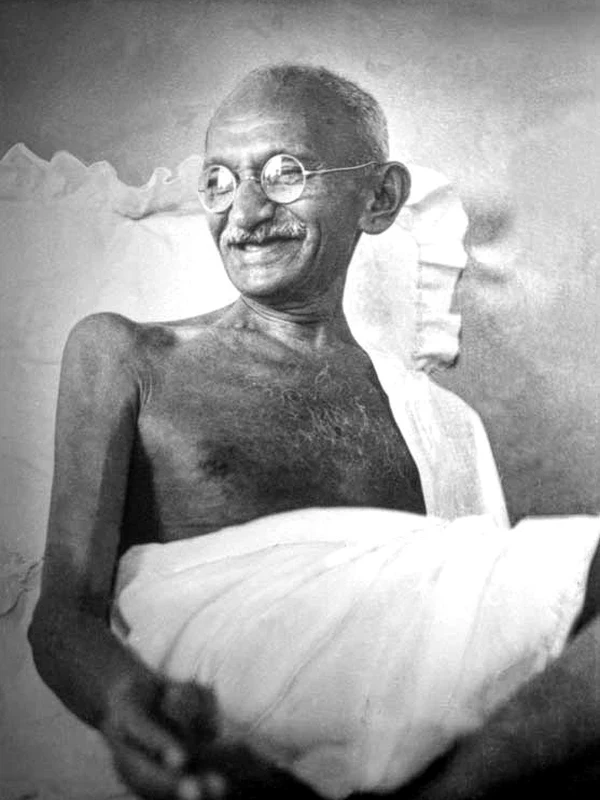
Indian lawyer and leader of the independence movement who developed satyagraha, nonviolent resistance — leading the Salt March and Quit India, and inspiring civil-rights movements worldwide.
Early Life
Mohandas Karamchand Gandhi was born on 2 October 1869 in Porbandar, a coastal town in Gujarat, the youngest son of Karamchand Gandhi, chief minister (dewan) of Porbandar, and Putlibai. He was married at 13 to Kasturba, in an arranged marriage customary at the time. In 1888 he sailed to London to study law, and was called to the bar at the Inner Temple in June 1891. In 1893 he travelled to South Africa to work for an Indian firm, expecting to stay a year; he remained for 21 years.
Education
Gandhi studied briefly at Samaldas College in Bhavnagar, then law in London at University College London and the Inns of Court School of Law. He was called to the bar at the Inner Temple in June 1891, aged 21.
Career
In South Africa Gandhi first experienced racial discrimination and organised the Indian community's resistance, founding the Natal Indian Congress in 1894 and developing satyagraha, nonviolent resistance, in campaigns from 1906. He returned to India in January 1915 and led peasant campaigns at Champaran in 1917 and Kheda in 1918. He took leadership of the Indian National Congress in 1921 and led the Non-cooperation Movement of 1920-1922. His most famous act was the Salt March of March-April 1930, a 400-kilometre walk to Dandi to break the British salt monopoly. He attended the Round Table Conference in London in 1931 and launched the Quit India Movement on 8 August 1942, after which he was imprisoned until May 1944. India became independent on 15 August 1947, partitioned into India and Pakistan. Gandhi was assassinated in New Delhi on 30 January 1948 by Nathuram Godse, a Hindu nationalist opposed to his efforts at reconciliation between Hindus and Muslims.
Achievements
Gandhi's achievement was to turn the Indian independence movement into a mass movement by making resistance something ordinary people could join: spinning cloth, making salt, refusing to cooperate with unjust laws. The Salt March of 1930 became the most famous act of civil disobedience in history, and the Quit India Movement of 1942 was the final mass campaign before independence. He served as president of the Indian National Congress in 1924-1925 and wrote widely, including Hind Swaraj (1909) and his autobiography, The Story of My Experiments with Truth. His birthday, 2 October, is observed in India as Gandhi Jayanti and worldwide as the United Nations' International Day of Non-Violence.
Legacy
Gandhi is widely regarded in India as the Father of the Nation and is honoured by the title Mahatma, Sanskrit for 'great soul'. His method of nonviolent resistance influenced Martin Luther King Jr., Nelson Mandela and civil-rights and freedom movements around the world. His legacy is also debated: historians note his opposition to Partition and his fasts for Hindu-Muslim unity, and some scholars have criticised language in his early South African writings about Black Africans, while others argue his views evolved substantially over his life. He was nominated for the Nobel Peace Prize several times, including in 1948, but was assassinated before the nominations closed and the prize was not awarded that year.
Major Achievements
- Founded the Natal Indian Congress in South Africa in 1894 and developed satyagraha, nonviolent resistance
- Led the Champaran campaign in 1917, his first major campaign in India
- Led the Non-cooperation Movement of 1920-1922 and took leadership of the Indian National Congress in 1921
- Led the Salt March of 1930, a 400-kilometre walk to Dandi that broke the British salt monopoly
- Launched the Quit India Movement on 8 August 1942, the final mass campaign before independence
- Wrote Hind Swaraj (1909) and The Story of My Experiments with Truth, his autobiography
- His birthday, 2 October, is observed worldwide as the International Day of Non-Violence
Contributions
Gandhi's contribution was a method: satyagraha, the disciplined refusal to cooperate with injustice without resorting to violence. He showed that a mass movement could be built on ordinary acts — spinning, marching, making salt — and that fasting and imprisonment could be political tools. His ideas about truth, simplicity and self-reliance shaped Indian nationalism and, through the movements he inspired, the civil-rights struggles of the twentieth century.
Notable Works
- Hind Swaraj (1909)
- The Story of My Experiments with Truth (autobiography, 1927-1929)
- Satyagraha in South Africa (1928)
Milestones
- 1869 — Born Mohandas Karamchand Gandhi on 2 October in Porbandar Source: Encyclopaedia Britannica
- 1891 — Called to the bar at the Inner Temple, London, in June Source: Encyclopaedia Britannica
- 1893 — Arrived in South Africa, where he first organised resistance to racial discrimination Source: Encyclopaedia Britannica
- 1894 — Founded the Natal Indian Congress Source: Encyclopaedia Britannica
- 1906 — Launched his first satyagraha campaign in South Africa Source: Encyclopaedia Britannica
- 1915 — Returned to India in January after 21 years in South Africa Source: Encyclopaedia Britannica
- 1917 — Led the Champaran campaign for indigo farmers Source: Encyclopaedia Britannica
- 1920 — Launched the Non-cooperation Movement; took leadership of the Indian National Congress in 1921 Source: Encyclopaedia Britannica
- 1924 — Served as president of the Indian National Congress (1924-1925) Source: Encyclopaedia Britannica
- 1930 — Led the Salt March from Sabarmati to Dandi, 12 March to 6 April Source: Encyclopaedia Britannica; History.com
- 1942 — Launched the Quit India Movement on 8 August with the call 'Do or Die' Source: Encyclopaedia Britannica
- 1947 — India became independent on 15 August, partitioned into India and Pakistan Source: Encyclopaedia Britannica
- 1948 — Assassinated in New Delhi on 30 January by Nathuram Godse Source: Encyclopaedia Britannica
Timeline
- 2 October 1869
Born in Porbandar, Gujarat, British India
Source: Encyclopaedia Britannica - 1883
Married Kasturba in an arranged marriage
Year only — exact date unknown Source: Encyclopaedia Britannica - 1891-06
Called to the bar at the Inner Temple, London
Approximate date Source: Encyclopaedia Britannica - 1893
Arrived in South Africa to work as a lawyer
Year only — exact date unknown Source: Encyclopaedia Britannica - 1894
Founded the Natal Indian Congress
Year only — exact date unknown Source: Encyclopaedia Britannica - 1906
Launched his first satyagraha campaign in South Africa
Year only — exact date unknown Source: Encyclopaedia Britannica - 1915-01
Returned to India after 21 years in South Africa
Approximate date Source: Encyclopaedia Britannica - 1917
Led the Champaran campaign for indigo farmers
Year only — exact date unknown Source: Encyclopaedia Britannica - 1920
Launched the Non-cooperation Movement
Year only — exact date unknown Source: Encyclopaedia Britannica - 12 March 1930
Began the Salt March from Sabarmati Ashram to Dandi
Source: Encyclopaedia Britannica; History.com - 8 August 1942
Launched the Quit India Movement with the call 'Do or Die' at Gowalia Tank, Bombay
Source: Encyclopaedia Britannica - 15 August 1947
India became independent; the country was partitioned into India and Pakistan
Source: Encyclopaedia Britannica - 30 January 1948
Assassinated at Birla House, New Delhi, by Nathuram Godse
Source: Encyclopaedia Britannica
In Their Words
“We shall either free India or die in the attempt.” Source: Mahatma Gandhi, Quit India speech, Gowalia Tank, Bombay, 8 August 1942 (Collected Works of Mahatma Gandhi) — From the speech launching the Quit India Movement, in which he gave the mantra 'Do or Die'.
Related Personalities
Frequently Asked Questions
Who was Mahatma Gandhi?
Mahatma Gandhi (1869-1948), born Mohandas Karamchand Gandhi, was an Indian lawyer and leader of the Indian independence movement. He developed satyagraha, nonviolent resistance, and led campaigns including the Salt March of 1930 and the Quit India Movement of 1942. He was assassinated in New Delhi on 30 January 1948.
Source: Encyclopaedia BritannicaWhat is satyagraha?
Satyagraha, a term Gandhi coined from the Sanskrit words for truth and firmness, is nonviolent resistance to injustice: refusing to cooperate with unjust laws while accepting the consequences, including imprisonment, without using violence. Gandhi first developed it in South Africa from 1906 and used it throughout the Indian independence movement.
Source: Encyclopaedia BritannicaWhat was the Salt March?
The Salt March of 1930 was Gandhi's protest against the British salt tax and monopoly. On 12 March 1930 he set out from Sabarmati Ashram with 78 followers and walked about 400 kilometres to the coastal village of Dandi, arriving in early April. On 6 April he broke the salt law by gathering salt from the sea, an act copied across India and followed by mass arrests.
Source: Encyclopaedia Britannica; History.comWhy was Gandhi assassinated?
Gandhi was shot on 30 January 1948 at Birla House in New Delhi by Nathuram Godse, a Hindu nationalist who opposed Gandhi's efforts at reconciliation between Hindus and Muslims after Partition. Gandhi was on his way to an evening prayer meeting when he was shot three times.
Source: Encyclopaedia BritannicaWas Gandhi ever awarded the Nobel Peace Prize?
No. Gandhi was nominated for the Nobel Peace Prize several times, including in 1948, but he was assassinated on 30 January 1948 before the nominations closed, and the Norwegian Nobel Committee decided not to award the prize that year.
Source: Encyclopaedia Britannica; Wikipedia (Mahatma Gandhi, cross-check)Sources & References
- Mahatma Gandhi — Encyclopaedia Britannica — Encyclopaedia Britannica (accessed 12 November 2026)
- Mahatma Gandhi — Wikipedia (cross-check) — Wikipedia (accessed 12 November 2026)
- August Kranti Maidan — Mumbai Legacy Project (Quit India speech record) — Municipal Corporation of Greater Mumbai (accessed 12 November 2026)
- File:Gandhi smiling 1942.jpg — Wikimedia Commons (portrait file page) — Wikimedia Commons (accessed 12 November 2026)
